Key Takeaways
- Your patio cover creates distinct microclimates – shade, transition, and full sun – that each requires different plant strategies to look cohesive and thrive over the long term.
- Drought-tolerant doesn’t mean dull. The right desert-adapted plants deliver resort-level beauty with a fraction of the water that traditional landscapes require.
- Coachella Valley Water District regulations and most local HOAs require drip irrigation and low-water plantings – professional design ensures compliance from day one.
- Hardscape borders, boulders, and decomposed granite create clean transitions between covered patios and planting zones, preventing the “disconnected” look.
- Landscape lighting is the finishing layer that ties your patio cover, plantings, and hardscape into one seamless outdoor environment after dark.
Here’s something we see all the time in the Coachella Valley. A homeowner invests in a stunning custom patio cover, a beautiful hardscape, maybe even an outdoor kitchen – and then the landscaping becomes an afterthought.
A few rocks here, a random cactus there… and suddenly a $75,000 outdoor living space feels incomplete.
The problem isn’t a lack of taste. It’s that most contractors treat the patio cover and the landscaping as two separate projects.
They aren’t. Your plants, your structure, and your hardscape all need to work as one unified design – particularly in a climate as demanding as ours.
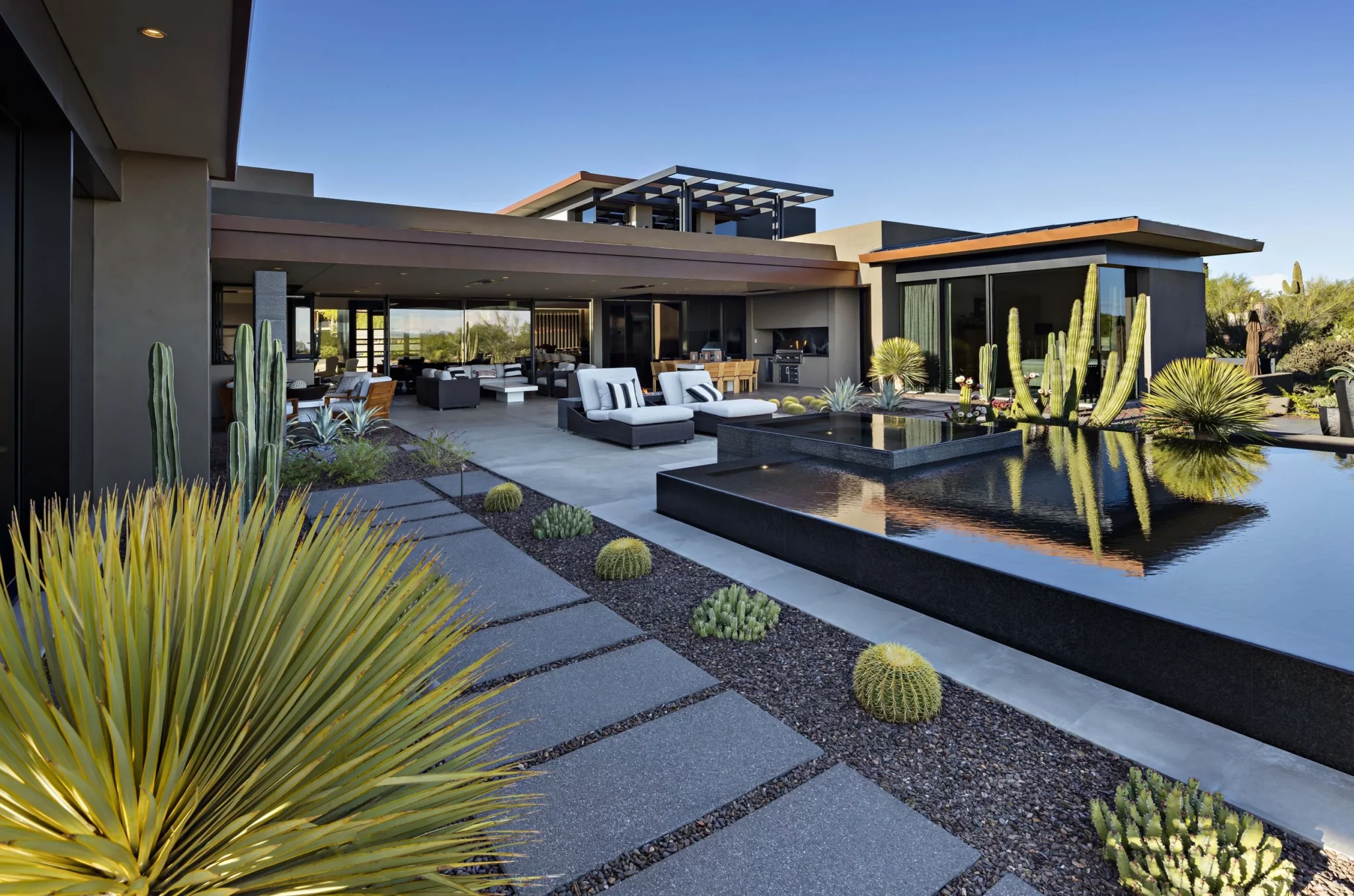
Let’s look at how to create drought-tolerant luxury landscaping that enhances your patio cover, respects Coachella Valley water rules, and delivers the kind of resort-style aesthetic that high-end homeowners expect.
Want to see how an integrated landscape and patio cover design could upgrade your outdoor space? Schedule a design consultation and let’s talk through the possibilities.
Why Do Your Patio Cover and Landscaping Need to Work Together?
A patio cover is an architectural focal point. But without thoughtful landscaping around it, even the most premium structure can look stark or disconnected from the rest of the yard.
Plants soften hardscape edges. They create visual transitions from indoor to outdoor. They establish “rooms” within your larger outdoor space.
In the Coachella Valley, where the intense sun makes everything outside the covered area feel barren, layered plantings turn a nice patio into a complete outdoor living environment.
Different Zones Need Different Plant Strategies
Your patio cover creates distinct microclimates across your yard, and each one needs a different approach:
- Under the cover (shade zone): Lower light, protected from wind, less water evaporation. Ideal for shade-tolerant succulents, container arrangements, and partial-shade species.
- Transition zone (edges of cover): Receives morning or late-afternoon sun. Perfect for vertical plantings that frame the structure and create visual depth.
- Full sun zones (open yard): Exposed to 110°F+ summer heat. Needs ultra-drought-tolerant species that won’t scorch or demand excessive watering.
When you plan all three zones together (rather than treating each as a separate decision), the result is a landscape that flows naturally from covered living space to open yard.
Cohesive Design Increases Home Value
Luxury buyers in Palm Desert, Rancho Mirage, and Indian Wells expect polished, professionally designed outdoor spaces.
Integrated landscape and patio cover design can boost perceived home value by 10–20%, especially in competitive desert resort markets.
Think of landscaping as an extension of your interior design philosophy: every element should feel intentional and harmonious.
What Should You Know About Coachella Valley’s Climate and Water Rules?
Our climate favors many stunning drought-tolerant species that would struggle anywhere else.
So the goal isn’t to fight the desert – it’s to embrace it with plants and materials that look incredible because of where we live, not in spite of it.
Water District Regulations
Coachella Valley Water District (CVWD) has water-efficient landscape ordinances that apply to new installations and major renovations.
Regulations typically limit turf to functional areas (play spaces, pet zones), require drip irrigation for most plantings, and mandate low-water plant species.
One important note: California Civil Code 4735 protects your right to install drought-tolerant landscaping, even if your HOA historically preferred lush lawns. They cannot prohibit desert-friendly plant choices.
That said, most communities still have aesthetic standards, plant lists, and approval processes – so it’s worth reviewing your CC&Rs before finalizing selections.
A professional landscape designer familiar with local regulations and HOA processes can streamline approvals and prevent costly surprises.
What Plants Work Best Around Your Patio Cover?
This is where the fun starts. Here are proven, luxury-appropriate picks for each microclimate your patio cover creates.
Shade Plants
Think of this as the “understory layer”. These are the plants that bring life to the edges and perimeter of your covered space without requiring full desert sun.
- Desert spoon (Dasylirion wheeleri): Architectural, silvery-blue foliage. Thrives in partial shade, very low water.
- Red yucca (Hesperaloe parviflora): Coral-pink blooms on tall stalks, tolerates shade under covers, attracts hummingbirds.
- Mangave hybrids: Low-growing, sculptural succulents with striking burgundy and blue-green coloring. Perfect for container groupings.
- Blue Chalksticks (Senecio mandraliscae): Bright blue groundcover succulent, excellent for edging hardscape under partial shade.
Design tip: Use potted arrangements and vertical planters to bring greenery into covered zones without conflicting with furniture or traffic flow.
Transition Plants
These taller accent plants go at the edges of your covered area, “framing” the patio cover and creating vertical interest.
- Texas ranger (Leucophyllum frutescens): Silver-gray foliage with vibrant purple blooms after rain. Medium shrub, thrives in part-sun to full sun.
- Yellow bells (Tecoma stans): Trumpet-shaped yellow flowers, attracts pollinators. Works beautifully as a “corner” plant at patio cover posts.
- Ocotillo (Fouquieria splendens): Dramatic vertical branching with red spring blooms. A striking architectural accent that doesn’t block views.
- Desert willow (Chilopsis linearis): Small ornamental tree with orchid-like blooms. Provides dappled shade near – but not under – the patio cover.
Design tip: Layer your heights. Place medium shrubs (3–5 feet) near patio cover edges, taller accents (6–10 feet) slightly farther out. This creates depth and visual flow.
Full-Sun Plants
These are the workhorses – ultra-drought-tolerant species that handle unrelenting Coachella Valley summer sun.
- Agave species: Bold, sculptural succulents that need almost no water once established. Excellent focal points in open areas.
- Palo verde: Native desert tree with green bark and yellow spring blooms. Provides filtered shade and year-round visual interest.
- Bougainvillea: For homeowners wanting color, heat-tolerant varieties trained on walls or fences bloom reliably in full desert sun.
- Mexican feather grass (Nassella tenuissima): Ornamental grass that adds soft movement and texture. Pairs beautifully with boulders and custom hardscape.
Design tip: Cluster plantings in “islands” rather than scattering individually. This creates visual impact, simplifies irrigation, and mimics natural desert plant communities.
Common Plant Mistakes to Avoid
- Non-desert turf grass: Excessive water demands, struggles in alkaline soil, often restricted by water districts.
- High-water ornamentals (hydrangeas, tropical species): Will scorch in Coachella Valley heat unless in deep shade with constant irrigation – not realistic or sustainable.
- Known invasive species: Mexican fan palm, Rosewood, and Fire Stick are prohibited in many desert cities.
- Heavy-litter trees near pools or patios: Certain mesquites and palms create maintenance headaches if placed too close to outdoor living areas.
How Do You Create Easy Transitions Between Hardscape and Landscape?
Hardscape elements – pavers, decomposed granite pathways, natural stone borders – visually separate the “patio room” from planting areas while still allowing movement through the space.
Paver & River Rock Borders
The most elegant approach is a 12–18-inch border of pavers or river rock along the edge of a patio cover, followed by layered plantings beyond. This prevents soil and mulch from migrating onto the hardscape during monsoon rains and creates a clean visual break that appears intentional.
Boulders
Boulders are iconic in luxury Coachella Valley landscapes. They add scale, anchor plant groupings, and create a genuine desert sense of place.
Select native desert boulders – granite or sandstone – that match the color palette of your patio cover and home exterior. Position them near corners of your structure or as visual anchors at the end of sight lines for that resort-quality layered look.
Decomposed Granite
For ground cover between plantings, decomposed granite (DG) in natural desert tones is the go-to choice for pathways and base layers.
River rock (1–3 inches) around plant bases reduces evaporation. Living groundcovers like Dymondia or Blue Chalksticks soften expanses of rock without the water demands of turf.
And a word of advice: skip dyed mulch and garish-colored lava rock. They date a landscape fast.
Add in Landscape Lighting as the Finishing Layer
Even beautiful plantings disappear at night. And Coachella Valley residents use outdoor spaces heavily in the evenings (when the temperature finally cooperates!)
Lighting enhances the visual impact of your landscaping, highlights the architecture of your patio cover, and creates the ambiance that makes evening entertaining feel special.
Think of it as the fourth layer after structure, hardscape, and plantings – the one that ties everything together after sunset.
A few techniques that work particularly well in the desert:
- Uplighting on accent plants: Spotlights at the base of Ocotillo, Agave, or Palo Verde trees create dramatic shadows and highlight sculptural forms.
- Path lighting along hardscape: Low-voltage LED fixtures guide movement from patio to garden areas and improve safety.
- Soffit and beam lighting on patio covers: Integrated LED strips or recessed fixtures illuminate the covered zone and wash light onto nearby plantings.
- Moonlighting from trees: Downlights in a mature Palo Verde or Desert Willow mimic natural moonlight filtering through branches. Absolutely stunning.
Pro tip: Use warm white LEDs (2700K–3000K) to complement desert tones. Cool blue-white lighting can feel harsh and clinical in outdoor settings.
Is It Time to Rethink Your Landscape Design?
If your outdoor space feels disjointed – a nice patio cover here, some random plantings there, no real flow between them – integrated landscape design is the answer. It’s the difference between a collection of outdoor elements and a true outdoor living environment.
Ask yourself:
- Does your landscaping complement your patio cover, or just coexist next to it?
- Are you confident your plants and irrigation comply with CVWD rules and your HOA’s guidelines?
- Does your yard look as polished at night as it does during the day?
- Could a professional eye turn what you have into something that genuinely feels resort-quality?
If any of those questions give you pause, a professional landscape design consultation can address plants, irrigation, lighting, hardscape transitions, and HOA compliance in one conversation.
Take the Next Step with Horizon Patios
Horizon Patios designs complete outdoor living environments where patio covers, landscaping, hardscapes, and lighting work together as one unified space – tuned specifically for the Coachella Valley’s climate.
Ready to bring it all together? Schedule your design consultation to start planning. Or browse our blog for more ideas on luxury outdoor living in the desert.
FAQ
What are the best drought-tolerant plants for a patio cover in the Coachella Valley?
Under patio covers, shade-tolerant species like Desert Spoon, Red Yucca, and Mangave hybrids perform well with minimal water. At the edges, transition plants like Texas Ranger and Desert Willow add height and color. In open sun areas, Agave, Palo Verde, and Bougainvillea are proven Coachella Valley performers.
Do I need HOA approval for landscape changes in the Coachella Valley?
Most Coachella Valley HOAs require pre-approval for landscape modifications. Common requirements include approved plant lists, color-matched hardscape materials, and restrictions on certain invasive species. However, California law (Civil Code 4735) protects your right to install drought-tolerant landscaping – your HOA cannot prohibit it.
How much water does a drought-tolerant desert landscape use compared to traditional turf?
A properly designed drought-tolerant landscape uses roughly 50–75% less water than traditional turf. With drip irrigation zoned for shade and sun areas, established desert-adapted plants may only need watering once or twice per week in summer – and even less in cooler months.
What type of irrigation works best for desert landscaping around a patio cover?
Drip irrigation is the standard for Coachella Valley landscapes and is required by CVWD regulations for most plantings. Zone your drip system so that shade plants under the patio cover receive 50–70% less water than full-sun zones. Weather-based smart controllers further optimize water use by adjusting schedules in response to real-time conditions.
How do you prevent landscaping from looking disconnected from a patio cover?
The key is designing all three zones together: shade plants under the cover, transition plants framing the structure, and drought-tolerant species in open areas. Hardscape borders (pavers, decomposed granite, boulders) create clean visual breaks between zones, and landscape lighting ties everything into one cohesive environment after dark.
What landscaping mistakes should I avoid in the Coachella Valley?
The most common mistakes are planting non-desert turf (excessive water use, often restricted), choosing high-water ornamentals that scorch in desert heat, placing heavy-litter trees near pools or patios, and using invasive species such as Mexican Fan Palm or Rosewood, which are prohibited in many local communities.