Key Takeaways
- No single cooling system solves desert heat alone – the most effective approach layers shade, misting, airflow, cool hardscaping materials, landscaping, and smart controls into a single integrated system.
- Rancho Mirage’s extreme dryness (27–28% summer humidity) is actually a superpower: it makes high-pressure misting systems extraordinarily effective, capable of dropping ambient temps by 20–35°F.
- Shade architecture is Layer 1 for a reason – a quality patio cover alone can reduce surface temperatures by 20–40°F, and every other cooling system performs significantly better underneath one.
- Hardscaping material selection is the most overlooked cooling factor: light-colored pavers and travertine stay 10–20°F cooler than dark alternatives, reducing radiant heat that rises from below.
- Smart controls tie everything together – especially for seasonal residents who want the patio cooled and ready before they arrive.
Most homeowners in the Coachella Valley don’t have a backyard problem. We work with different homes all the time, and most of the issues come down to a system problem.
Living in this area is incredible. But when summer hits, even the most beautifully designed patio becomes a no-go zone.
That means four months of your outdoor investment just sit there, baking. Not being enjoyed.
But the same extreme dryness that makes those summers brutal (27–28% humidity) is exactly what makes desert cooling solvable.
It’s that low humidity is the secret weapon for evaporative cooling, and why properly designed systems work dramatically better here than in Houston or Miami.
Let’s walk through a six-layer cooling framework we use to design outdoor spaces across Rancho Mirage, Palm Desert, La Quinta, and the broader Valley – spaces that stay comfortable even when the thermometer crosses 120°F.
No single product does it alone. But layered together, these systems turn an unusable summer patio into the best room in your house.
What Is the Layered Cooling Framework?
The core insight here is simple: desert heat attacks your patio from multiple directions, so your outdoor cooling solutions need to work on multiple fronts.
Solar radiation beats down from above. Hardscape surfaces absorb and radiate heat from below. And the ambient air temperature itself hovers at triple digits.
The six layers, in order of priority:
- Shade Architecture — block the solar load at the source
- High-Performance Misting — cool the ambient air through evaporation
- Ceiling Fans & Airflow — circulate and amplify the cooled air
- Hardscape Material Selection — eliminate radiant heat from below
- Strategic Landscaping — build a natural micro-climate around the patio
- Smart Controls — automate and optimize everything, especially for second homes
Each layer makes the others more effective.
Skip one, and the rest have to work harder. Nail all six, and you’ve got a patio that performs like a modern desert luxury space should.
Layer 1: Shade Architecture — Block the Heat at the Source
Every other cooling system works harder and costs more if you skip this step. Shade structures alone can reduce patio surface temperatures by 20–40°F in covered zones.
Even 50% shade coverage delivers a 12–18°F reduction. This is always the foundation layer.
For Coachella Valley homes, two types of luxury patio covers are typically encouraged:
Solid and Insulated Patio Covers
Solid and insulated patio covers provide permanent, full-coverage shade with insulated panels that reduce heat transfer from above, not just block sunlight. No moving parts, minimal maintenance, clean architectural lines.
Motorized Louvered Pergolas
Motorized louvered pergolas offer adjustable slats (up to 170°) for variable shade and airflow control, with native smart home integration – app control, remote operation, and automatic wind/rain/temperature sensors.
The material choice between 4K Aluminum and Alumawood depends on your home’s architecture, HOA requirements, and how much tech you want overhead.
Bottom line: in our climate, the patio cover isn’t decoration. It’s infrastructure. Everything else performs much better under proper shade.
Layer 2: High-Performance Misting — The Desert’s Secret Weapon
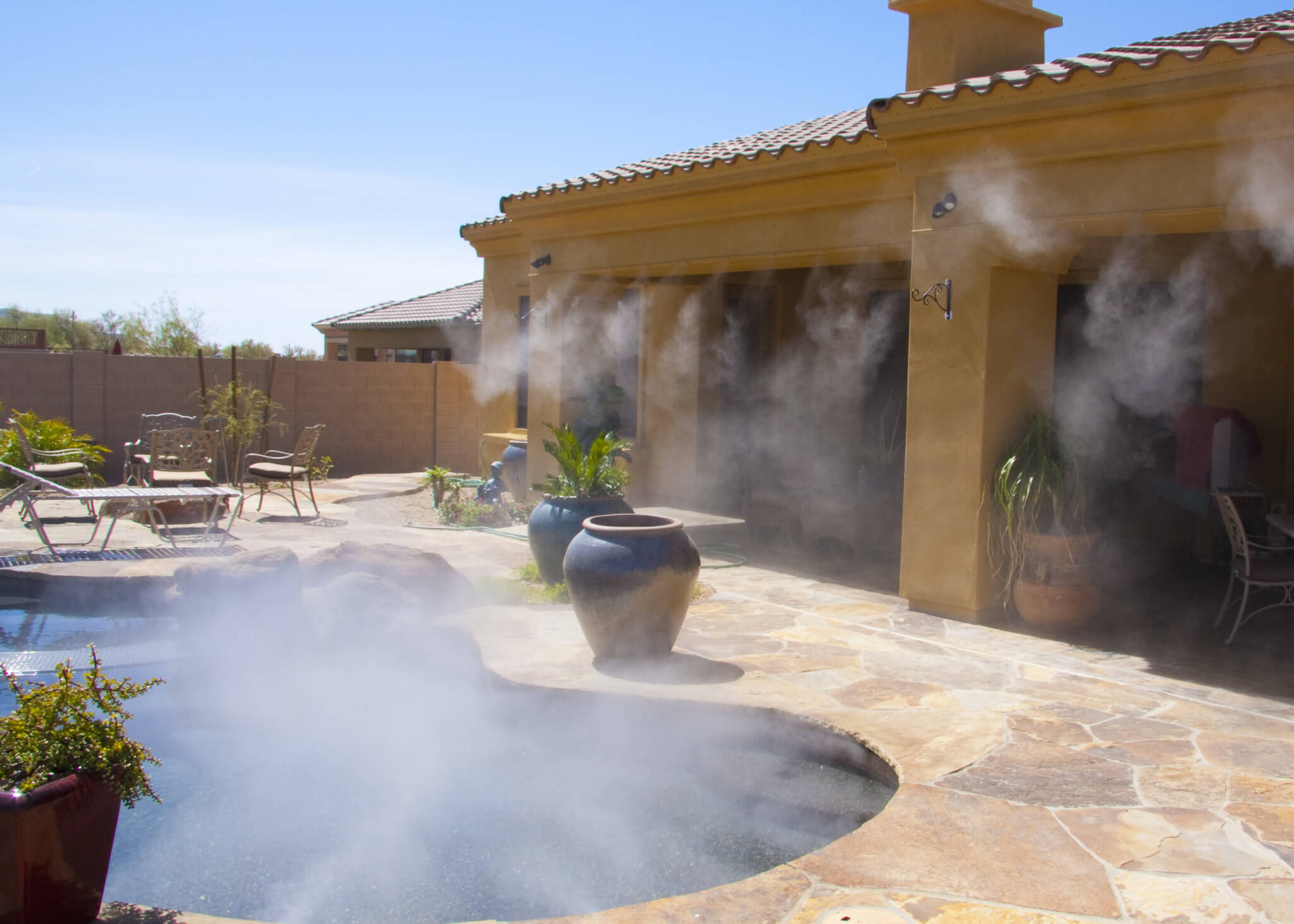
At 27–28% summer humidity, water droplets from a high-pressure misting system evaporate almost instantly. As they evaporate, they absorb heat from the surrounding air.
The result? A professional misting system can drop ambient temperatures by 20–35°F. A 110°F patio day can feel like 75–80°F under a properly designed perimeter system.
But not all misting systems are created equal!
| System | Pressure | Temp Drop | Wetness | Desert Verdict |
| Low-Pressure | 35–60 PSI | Minimal | Soaks surfaces | Not appropriate for luxury patios |
| Mid-Pressure | 150–300 PSI | 10–15°F | Some dampness | Acceptable for smaller spaces |
| High-Pressure | 700–1,000+ PSI | 20–35°F | Dry — instant evaporation | The only professional choice for desert luxury |
High-pressure systems are the only appropriate choice for luxury desert patios. The mist evaporates before it reaches your furniture, your guests, or your flooring – no wet surfaces, no dampness, just cooler air.
Low-pressure is the garden-store version that soaks everything. If someone quotes you a misting system and it’s not high-pressure, keep looking.
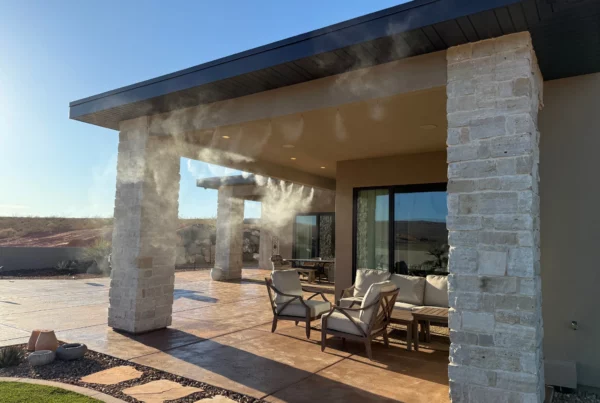
Placement matters too. Under a covered patio with less than 20 feet of depth, perimeter misting lines create a “curtain of cooled air” around the seating zone.
For open-air patios or supplemental cooling, misting fans combine evaporative cooling with air circulation.
Make sure to check out our complete guide to misting systems, which goes deeper on system types, costs, and installation details.
Layer 3: Ceiling Fans — The Amplifier
Let’s be clear about what fans do and don’t do.
On their own in 110°F heat, a ceiling fan just moves hot air around. You might feel a 5–7°F wind-chill effect on your skin, but the air isn’t actually cooler.
Paired with misting, however, fans become essential. Fan blades accelerate evaporation of mist droplets, which lowers the actual air temperature, making the misting system significantly more effective per gallon of water used.
Think of fans as the amplifier in your cooling system, not the engine.
Look for a minimum 4,000 CFM rating for spaces up to 400 square feet, IP65-rated housings (dust-tight and water-resistant, which matters when you consider sand and dust storms), and DC motors for quiet operation at variable speeds.
Layer 4: Hardscape Materials — Eliminate Radiant Heat from Below
Your patio cover can block solar radiation from above, your misting system can cool the air, and your fans can circulate it.
But if the floor underneath is dark pavers baking at 150°F and radiating heat back upward, you’ll end up fighting physics from both directions.
Light-colored hardscape materials make all the difference here.
Travertine is the gold standard for desert patios – its porous structure disperses heat, keeping surfaces 10–20°F cooler than dark pavers. White and light-colored stone can reflect 60–70% of solar radiation, reducing surface temperatures by 20–35°F compared to dark slate or charcoal concrete.
The functional choices also happen to be the most aesthetically appropriate for luxury desert homes. Warm sand tones, cream limestone, and light travertine look stunning against desert landscaping – and they don’t punish bare feet on an August afternoon.
Getting this right at design time is important because hardscape and patio cover design that works together starts with material choices that serve both beauty and comfort.
Layer 5: Strategic Landscaping — Build a Natural Micro-Climate
Did you know that your plants and trees can work as an active cooling system?
Air temperatures directly under shade trees can be up to 25°F cooler than above nearby pavement.
Shade (not transpiration or evaporation) is the primary cooling benefit trees provide, which means desert-adapted species that don’t need heavy watering still deliver a big cooling impact.
The best placement for shade trees is on the southwest side of the patio, where they intercept the intense afternoon sun, making 3–6 PM the hardest hours to be outside. Desert palms, mesquite, and desert willow all work great here.
Below the tree canopy, shrubs and ground covers reduce heat reflection off hard surfaces, and layered drought-tolerant landscaping creates a buffer zone that insulates the patio from surrounding exposed hardscape, walls, and streets.
Layer 6: Smart Controls — Automate and Optimize
For full-time Coachella Valley residents, smart controls mean set-it-and-forget-it comfort. You can have motorized louvers that adjust based on sun position and temperature sensors, and misting systems that activate automatically when it hits 95°F.
Imagine this: you schedule your smart-integrated misting system and motorized patio cover to cool the patio before you land at Palm Springs Airport – and you’re ready to enjoy the results the moment you get home.
Wind sensors automatically close louvers if a storm rolls in while you’re away. Your outdoor space is protected and comfortable without you lifting a finger. This is the luxury upgrade that pulls all of this together.
Your Desert Cooling System at a Glance
| Cooling Layer | What It Does | Impact in Desert Conditions |
| Shade Architecture | Blocks solar radiation from above | 20–40°F surface temp reduction |
| High-Pressure Misting | Cools ambient air through evaporation | 20–35°F air temp drop |
| Ceiling Fans | Circulates cooled air, amplifies misting | Up to 7°F additional wind-chill effect |
| Light Hardscape | Reflects solar energy, reduces radiant heat | 10–20°F cooler than dark surfaces |
| Strategic Landscaping | Creates natural micro-climate and shade | Up to 25°F cooler under tree canopy |
| Smart Controls | Automates and optimizes all systems | Set-and-forget comfort, remote prep |
Remember: the combined effect of shade + misting roughly doubles the cooling improvement of either system alone!
Is Your Patio Ready for Next Summer?
If your outdoor space becomes a ghost town from June through September, it’s time to implement a system designed for desert heat.
When each layer is designed as part of a single integrated plan, a 120°F day doesn’t mean retreating inside. It means stepping onto a patio that’s 75–80°F and wondering why you waited so long.
Horizon Patios designs and builds integrated outdoor cooling systems for homes across the Coachella Valley – custom patio covers, professional misting systems, designer hardscapes, and luxury landscape design, all engineered for desert performance.
Schedule your consultation and let’s design a cooling system that makes your patio the best room in the house – even in August. You can also browse our blog for more desert living guides tailored to Coachella Valley homeowners to get inspired!
FAQ
How much can a misting system reduce patio temperature in the desert?
In dry desert climates with humidity below 30%, a high-pressure misting system (700–1,000+ PSI) can lower air temperature by 20–35°F. At Rancho Mirage’s summer humidity of 27–28%, a 110°F day feels like 75–80°F under a well-designed perimeter misting system. Low-pressure systems are less effective and leave surfaces wet.
What is the best patio cover for extreme desert heat?
Insulated solid patio covers greatly lower surface temperatures by 20–40°F in desert climates, offering maximum heat protection. Motorized louvered pergolas provide adjustable shade and smart home features, perfect for shoulder seasons and flexibility. Luxury homes often use both in different zones.
Why do hardscape materials matter for patio cooling?
Dark hardscape absorbs solar energy and radiates heat upward, warming the patio below even in shade. Light-colored materials like travertine, cream pavers, and sandstone stay 10–20°F cooler and reflect 60–70% of solar radiation. Material choice permanently affects outdoor comfort year-round.
Do outdoor ceiling fans actually help cool a desert patio?
Fans alone only create a wind-chill effect (about 5–7°F perceived cooling) by moving air across skin. When combined with a misting system, fans significantly improve cooling by speeding up mist evaporation and lowering air temperature. In desert conditions, fans mainly amplify misting rather than providing standalone cooling.
What trees help cool a desert patio?
Desert-adapted trees like mesquite, desert willow, and some palms can lower air temperatures by up to 25°F under their canopy compared to pavement. In desert climates, shade offers more cooling than evapotranspiration, so even low-water species help. Place trees on the southwest side of the patio to block the afternoon sun.
Can smart controls really make a patio cooler?
Smart controls optimize the cooling system with motorized louvers adjusting by sun and temperature, misting activated by thresholds, and automated fan speeds. For part-time residents, smart integration allows remote patio cooling and preparation. Wind and rain sensors also automatically protect structures when you’re away.