Key Takeaways
- A professionally installed high-pressure misting system typically uses 1–2 gallons per hour per nozzle — comparable to a long shower for the entire session.
- Most Coachella Valley homeowners spend well under $15/month in water running a misting system through peak summer — even with daily use.
- High-pressure systems cool outdoor spaces by 15–30°F in desert conditions by evaporating water before it ever reaches your furniture or floors.
- High-pressure systems are significantly more water-efficient than low-pressure DIY kits, which waste water through large, un-evaporated droplets.
- A quality system with annual maintenance is designed to last 10+ years — making the water cost a small fraction of the outdoor investment it protects.
A common assumption we get is that a misting system must use a ton of water, and running one all summer would show up on the bill in a big way.
We get that concern — especially in the desert. But the reality is that with high-pressure professionally installed systems, it is almost the opposite of what most people expect.
We’ll walk you through the actual numbers — gallons per hour, monthly cost scenarios, how evaporative cooling works in the Coachella Valley’s dry summer heat, and why the type of system you choose matters far more than whether you run it.
How Much Water Does a Patio Misting System Actually Use?
Water use in a misting system comes down to three factors: nozzle count, nozzle flow rate, and operating pressure. Those three variables determine whether a system is genuinely efficient or quietly wasteful.
For a professionally installed high-pressure system, the standard benchmark is roughly 1–2 gallons per hour per nozzle at operating pressure. A mid-size residential setup in the Coachella Valley might run 10–15 nozzles, placing total system consumption in the range of 10–25 gallons per hour depending on configuration. For context:
- A typical American shower uses 15–20 gallons of water total
- Ten minutes of lawn irrigation can push 50–70 gallons through a standard sprinkler
- A single outdoor garden hose running for 30 minutes uses roughly 150 gallons
Measured against other household outdoor water uses, an hour of high-pressure misting compares favorably — and often runs less water than you’d guess.
Independent testing confirms that high-pressure systems operating at 800–1,200 PSI use significantly less water per hour than mid-pressure or low-pressure alternatives, because the finer the droplet, the more efficiently it evaporates and the less falls to the ground unused.
A standard nozzle at 1,000 PSI uses approximately 1.25 gallons per hour — and a full system is only running as many nozzles as the design calls for.
Want to understand how your specific space would be designed? Our guide to misting systems in the Coachella Valley covers the full picture — from nozzle placement to integration with patio cover structures.
What Does It Cost to Run a Misting System in Palm Springs?
Water in the Coachella Valley, like most of Southern California, runs well below one cent per gallon for residential use.
Using a conservative estimate of around half a cent per gallon, the math on a misting system might surprise you!
Here’s how monthly operating costs break down across three realistic usage profiles — all based on a 15-gallon-per-hour system, which is a reasonable mid-range estimate for a professionally designed residential setup:
| Usage Profile | Run Time | Monthly Water | Est. Water Cost |
|---|---|---|---|
| Weekend entertainer | 4 hrs × 3 days/week | ~720 gal/month | ~$3–5/month |
| Evening regular | 3 hrs × 7 days/week | ~1,350 gal/month | ~$6–8/month |
| Heavy summer user | 6 hrs/day, June–Sept | ~2,700 gal/month | ~$12–15/month |
Even at the heavy end of daily summer use, you’re looking at roughly $12–15 per month in water — a number that tends to surprise people.
Water is the primary operating expense for these systems, and it remains the smallest line item relative to the comfort value delivered.
What About Electricity?
The high-pressure pump adds a modest electrical draw — typically a fraction of what your indoor AC compressor consumes at full load. In practical terms, running the pump adds at most a few dollars per month during peak use.
Some homeowners find that keeping guests comfortable outdoors actually reduces their total electricity bill by decreasing the demand on interior cooling when the house is full.
| The real cost question |
| For a homeowner who has invested $50,000–$150,000 in an outdoor living space, the question isn’t whether $12/month in water is affordable. The question is: does the misting system let you actually use that space from May through September? If yes, it’s the highest-ROI item in the entire project. |
Do Misters Actually Work in 110°F Desert Heat?
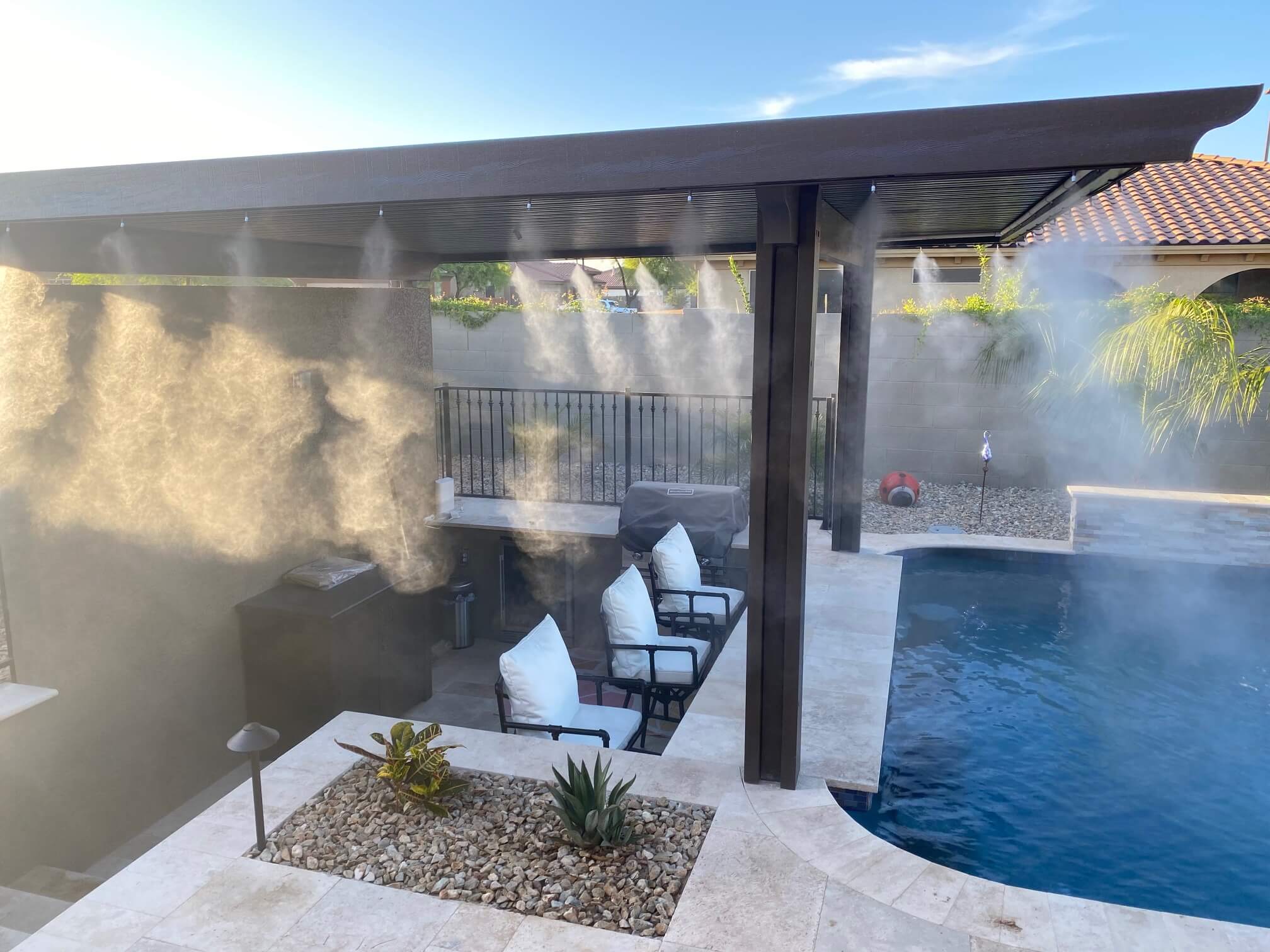
Misting systems work through evaporative cooling: ultra-fine water droplets are sprayed into the air, where they absorb heat as they evaporate, pulling the ambient temperature down in the process. The drier the air, the faster evaporation happens — and the more dramatic the cooling effect.
This is where the Coachella Valley’s climate becomes an advantage rather than an obstacle. Summer humidity regularly sits below 15–20%. That’s nearly ideal for evaporative cooling.
A well-designed high-pressure system under these conditions can reduce the perceived temperature in the misted zone by 15–30°F (sometimes more) when the right patio cover structure provides overhead shade.
Won’t It Make the Air Feel Humid?
High-pressure systems create droplets measured in microns — fine enough that most of the water evaporates before it reaches seating height.
You feel the cooler air, not a spray. The surfaces stay dry, the furniture stays dry, and the experience is notably different from the “damp fog” effect you get from garden-hose-pressure DIY kits.
Low-pressure systems produce larger droplets that don’t fully evaporate. In an enclosed or semi-enclosed patio area, which can create exactly the humid, clammy feeling people are trying to avoid.
It’s one of the most common reasons homeowners report being “disappointed” with misting — they bought the wrong type of system.
Research on misting in various climates confirms it: high-pressure systems designed for desert conditions perform in a fundamentally different category.
High-Pressure vs. Low-Pressure
The comparison between high-pressure and low-pressure systems isn’t just a marketing distinction — it determines the actual experience, the water efficiency, and whether the system earns its place in a luxury outdoor space. Here’s how they stack up:
| Feature | High-Pressure System | Low-Pressure / DIY Kit |
|---|---|---|
| Operating pressure | ~800–1,200 PSI | ~40–100 PSI |
| Droplet size | Ultra-fine — evaporates mid-air | Larger drops, often visible |
| Cooling effect (desert) | 15–30°F+ reduction | Modest; can feel spray-like |
| Water efficiency | High — most water evaporates | Lower — water falls unused |
| Comfort level | Cooler air, no wet feeling | Can leave surfaces damp |
| Best for | Luxury desert patios, permanent installs | Budget cooling, mild climates |
For permanent desert installations — whether you’re in Palm Springs, Rancho Mirage, La Quinta, or Indian Wells — high-pressure is the design standard.
The higher upfront cost reflects the pump, filtration, and professional installation required, but it’s also what separates a system that performs beautifully from one that frustrates you all summer.
Check out our misting systems service page to see the specific system types we install and how we design them to integrate with patio cover structures for maximum cooling efficiency.
How Long Does a Residential Misting System Last?
A quality high-pressure system, built with stainless steel lines and commercial-grade components and properly maintained, is designed to deliver a decade or more of reliable service.
The pump is the primary mechanical component; nozzles and filters are the consumable parts that need periodic attention.
What Does Annual Maintenance Look Like for a Misting System?
Think of it like pool equipment or an outdoor HVAC system — a pre-season service visit once a year handles the critical items:
- Replacing nozzle filters (especially important with the Coachella Valley’s hard water)
- Cleaning or replacing nozzles to clear mineral deposits
- Flushing lines to remove buildup
- Pump oil change and inspection if applicable
- Testing all zones for coverage and alignment
For seasonal residents, this pre-season check is particularly valuable — your system sits dormant through summer and needs to be confirmed ready before you arrive for the season.
We coordinate that as part of our ongoing service relationship with clients throughout the valley.
Is the Water Use Worth It?
A high-pressure residential misting system in the Coachella Valley typically runs $3,000–$6,000 installed for a residential patio, depending on size and complexity.
Across a five-month summer, the operating cost in water averages $40–75 total at typical usage levels — not per month, for the whole season.
Set that against what the system actually delivers: the ability to use a covered patio, pool deck, or outdoor kitchen space from May through September, rather than retreating indoors for four months.
For most of our clients who’ve invested significantly in their outdoor living space, that’s not a close calculation.
For the homeowner who entertains regularly, the system pays for itself in comfort and hospitality value well within the first season.
For the seasonal resident arriving in October, a well-maintained misting system means arriving to a functional, resort-quality outdoor space rather than a space you have to acclimate to using again.
High-pressure systems are also among the most water-efficient cooling options available for outdoor spaces.
Because most of the water evaporates in mid-air rather than falling to the ground, efficiency analyses find that high-pressure designs maximize cooling per gallon. Plus, adding smart controls or timers to cycle the system during peak heat hours further reduces consumption.
Curious what a misting system integrated into your specific outdoor space would look like? Visit our patio cover and misting solutions pages or take a look at recent projects to see how we combine shade structures and misting for complete summer performance.
Ready to Design Your Desert Cooling System?
Every misting system we design starts with a site visit — because nozzle placement, operating pressure, and integration with your patio cover or shade structure all affect performance in ways that a generic spec sheet can’t capture.
Schedule a consultation, and we’ll walk through what a properly designed high-pressure system would look like for your specific space, from Palm Springs to La Quinta to Rancho Mirage.
Frequently Asked Questions
How much water does a misting system use per hour?
A professionally installed high-pressure patio misting system uses 1–2 gallons per hour per nozzle. A typical 10–15 nozzle residential system consumes 10–25 gallons per hour, costing under $0.15 per hour in the Coachella Valley.
Do misting systems use a lot of water compared to other outdoor uses?
High-pressure misting systems are very water-efficient for outdoor cooling. An hour of misting typically uses less water than a 10-minute irrigation session. High pressure is key, as it atomizes water into micron-sized droplets that evaporate immediately, maximizing cooling with minimal water.
How much does it cost to run a misting system per month in the Coachella Valley?
Most residential water users in the Palm Springs area (Palm Desert, La Quinta) pay approximately $3–$ 15 per month, depending on usage. For example, a homeowner running an evening system for three hours during summer typically spends $6–8/month. Even heavy daily summer use (a four-month season) totals only $40–60.
Will a misting system make my patio feel humid?
Properly designed high-pressure misting systems use fine droplets that evaporate in mid-air, cooling the surroundings without getting surfaces wet or creating humidity. Low-pressure DIY systems produce larger droplets, causing dampness and a humid sensation, often leading to disappointment.
How much can a misting system cool my outdoor space in the desert?
High-pressure misting systems in the Coachella Valley’s low-humidity summers can lower the perceived temperature in the misted zone by 15–30°F, sometimes more with overhead shade. The dry air accelerates evaporation, making the Coachella Valley an ideal environment for misting-driven cooling. See our full misting system guide for more on how system design affects cooling performance.
How long does a residential misting system last?
Properly maintained high-pressure systems are designed to last 10 years or more. While the pump, stainless steel lines, and fittings are built for long-term use, nozzles and filters require periodic replacement. Our annual pre-season service ensures peak performance and proactively addresses potential wear.