Horizon Patios Editorial Team | 12 Minute Read | April 2026
Key Takeaways
- • Within 3–5 miles of the Newport Beach coastline, airborne salt accelerates corrosion and degrades standard materials. Only premium powder-coated aluminum — AAMA 2604 rated — and marine-grade hardware are built to hold up long-term.
- • Extruded 6061-T6 aircraft-grade aluminum with AAMA 2604 advanced powder coating — engineered for UV resistance and salt air durability. Available exclusively through authorized dealers like Horizon Patios.
- • A patio cover for a Mediterranean Newport Coast estate requires a completely different design approach than one for a modern coastal build in Corona del Mar. Design consultation is not optional in this market.
- • Approximately 47% of Newport Beach is within the California Coastal Zone. Properties in that zone require a Coastal Development Permit (CDP) in addition to a standard building permit. Horizon manages the full permitting process.
- • With 280+ sunny days and mild year-round temperatures, Newport Beach outdoor spaces can be used 12 months a year — with the right cover. Quality outdoor living consistently returns 60–80%+ ROI at resale in coastal SoCal markets.
Newport Beach homeowners don’t settle for second-best indoors.
The kitchens are custom, the finishes are intentional, and every detail reflects the value of the property. Then you step outside, and the patio cover looks like it came from a big-box home improvement store.
We’ve seen it more times than we can count — a $4 million home in Corona del Mar or a Pelican Hill estate with a builder-grade cover that’s already fading, oxidizing, or simply doesn’t match the architecture. It’s not a budget problem.
It’s a knowledge gap about what coastal living actually demands from an outdoor structure.
Why Does Newport Beach Demand a Different Kind of Patio Cover?
Because the coastal environment here is harder on outdoor structures than almost anywhere else in Southern California — and the homes are too valuable to get it wrong.
Newport Beach isn’t a heat problem the way the Coachella Valley is. Summer highs run in the mid-70s to low-80s°F — genuinely mild by California standards. What Newport Beach does have is a persistent coastal environment that tests outdoor materials year-round.
Salt air is the primary factor. Airborne salt from the Pacific extends 3–5 miles inland depending on prevailing winds, and for properties on Balboa Island, the Peninsula, or Lido Isle — properties that sit directly on the water — that concentration is at its highest.
Salt particles settle on every exposed surface, find microscopic imperfections in coatings, and begin the corrosion process from the inside out.
Standard materials don’t survive it gracefully. Wood absorbs airborne salt and moisture, leading to swelling, splitting, and structural decay within a few seasons. Vinyl and PVC become brittle under UV exposure and thermal cycling. Even standard aluminum can develop pitting corrosion over time without the right protective coating.
Add 280+ sunny days of UV exposure annually, coastal wind that demands proper structural engineering, and the aesthetic standard set by homes with median prices starting at $3.4 million — and it becomes clear that a commodity patio cover installation isn’t a fit for this market.
Ready to design your Newport Beach outdoor space? Our team handles everything — design, permits, and installation.
Get a Free Consultation →Which Patio Cover Materials Are Actually Built for the Newport Beach Coast?
Three material systems are genuinely engineered for what coastal OC throws at an outdoor structure. Everything else is a compromise you’ll be paying for within a few years.
4K Aluminum
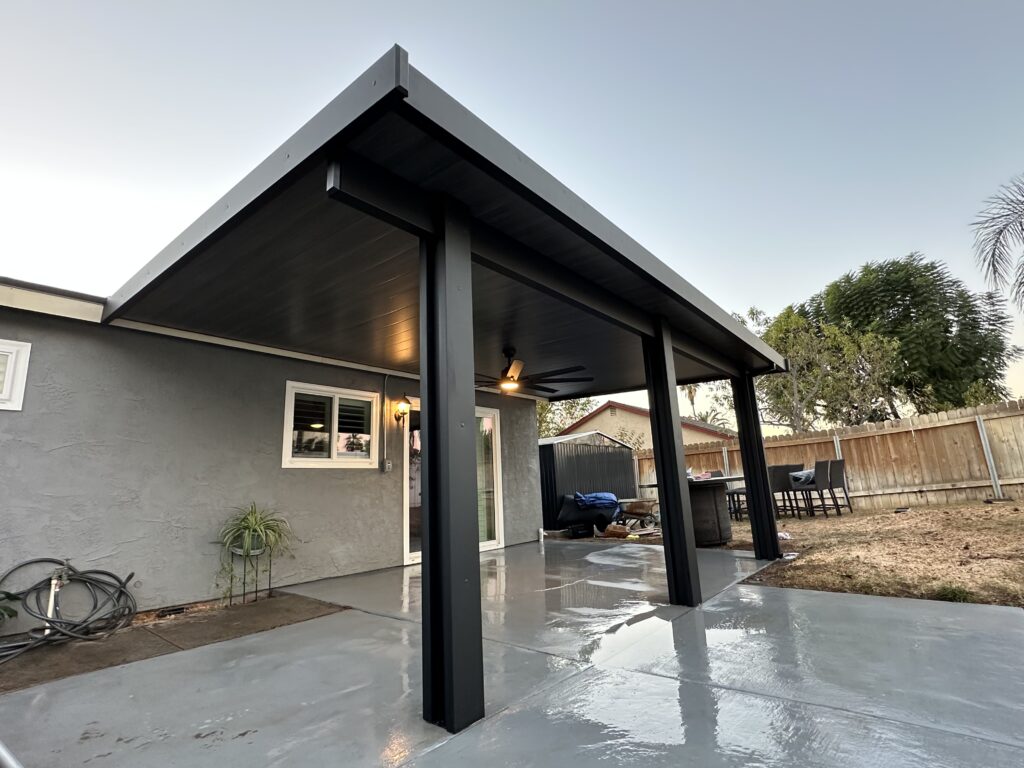
Our 4K Aluminum system is built from extruded 6061-T6 aircraft-grade aluminum — 25% thicker than standard roll-formed retail alternatives.
The finish is AAMA 2604 advanced powder coating, a specification that isn’t marketing language — it’s an industry performance standard that certifies the coating’s resistance to salt fog, UV degradation, and color retention over time.
What that means in practical terms: the coating forms a protective oxide layer that actually strengthens in salt air rather than degrading.
It’s engineered specifically for coastal and high-UV environments, and it’s why this system is the preferred material in Newport Beach, Newport Coast, and comparable luxury coastal communities across Southern California.
The structural specs matter here too. The 4K system is rated for 120–130+ mph wind loads and engineered for longer spans with fewer posts — which is what allows the dramatic floating rooflines and clean cantilevers that complement modern coastal architecture.
It’s available exclusively through authorized dealers, and that limited availability is intentional.
Alumawood
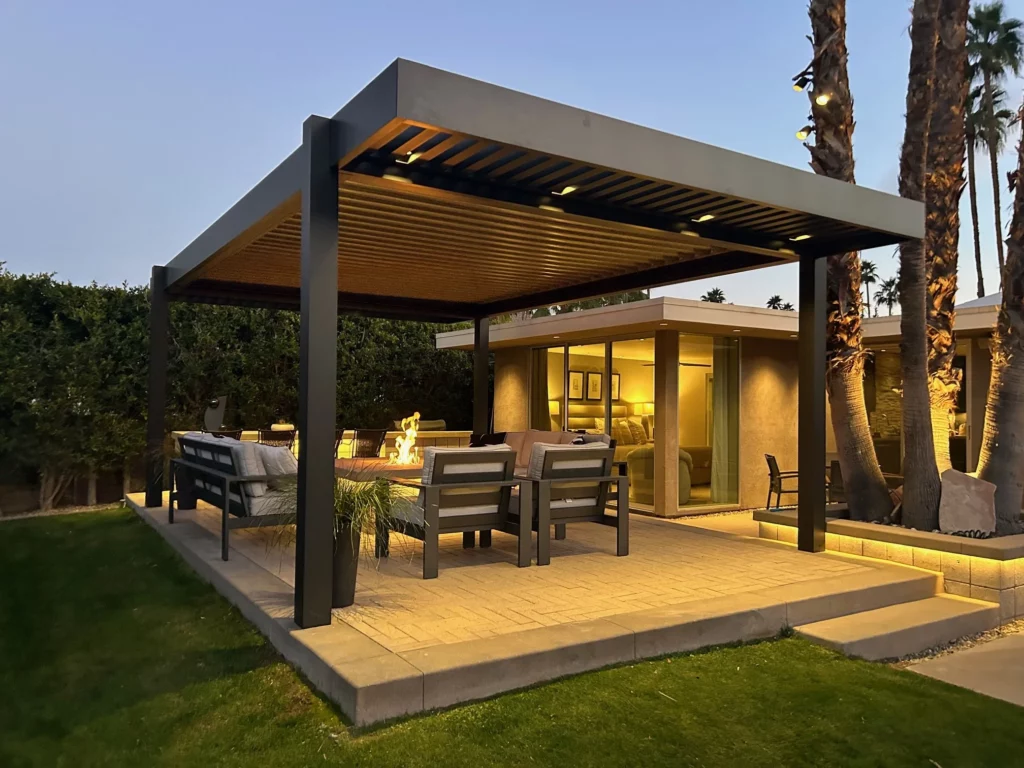
Alumawood brings the warmth of authentic wood grain texture to aluminum construction. For homes in Newport Beach’s traditional architectural styles — Cape Cod on the Port Streets, Mediterranean in Newport Coast, Spanish Colonial in Corona del Mar — the visual warmth of a wood-finished cover is often the right call architecturally.
The durability holds up to coastal demands. Alumawood’s proprietary DuraTough Coating™ and Aluma-Shield® paint system with Teflon® surface protector are specifically engineered for extreme UV and coastal conditions.
It won’t warp, crack, or require repainting — which matters for homeowners who don’t want to be scheduling maintenance visits every season.
The honest trade-off: Alumawood is not an insulated system, so it doesn’t provide the thermal performance of a 4K insulated panel. In Newport Beach’s mild climate, that’s rarely the deciding factor. The architectural match usually is.
Motorized Louvered Roofs
For homeowners who want year-round flexibility across Newport Beach’s four genuinely distinct seasons, a motorized louvered roof is the premium choice.
Adjustable aluminum louvers rotate to control sunlight angle, airflow, and rain protection — and the smart home integration means you can adjust settings from your phone before you arrive from your other property.
The coastal engineering angle is worth noting: when louvers are open, they reduce wind uplift forces by allowing air to pass through rather than creating a solid surface for wind pressure to act against.
When closed, they form a watertight roof that channels winter rain through internal gutters. For Newport Beach’s December through March rainfall season, that matters.
Patio Cover Materials for Newport Beach Coastal Homes: What Holds Up and What Doesn’t
| Material | Salt Air | UV Resistance | Wind Rating | Lifespan | Best Match |
|---|---|---|---|---|---|
| 4K Aluminum | Excellent (AAMA 2604) | Excellent | 120–130+ mph rated | 30+ years | Modern Coastal, Contemporary, any style |
| Alumawood | Excellent (DuraTough™) | Excellent | Good | 25–30 years | Mediterranean, Cape Cod, Traditional |
| Motorized Louvered | Excellent | Excellent | Excellent | 25–30 years | All styles — maximum flexibility |
| Standard Aluminum | Good (coating-dependent) | Moderate | Good | 15–20 years | Budget installs — not recommended for luxury |
| Wood | Poor | Poor | Poor | 3–7 yrs w/ maintenance | Not recommended for coastal Newport Beach |
| Vinyl / PVC | Poor | Poor — brittle | Poor | 2–5 years | Not recommended for coastal OC |
Source notes: Lifespan and performance ratings based on manufacturer specifications, AAMA 2604 coating standards, and coastal materials industry data. Wind rating based on 4K system engineering specifications.
How Do You Match a Patio Cover to Newport Beach’s Architectural Styles?
This is the question most contractors don’t ask — and it’s the one that separates a patio cover that looks like it belongs from one that looks like it was bolted on as an afterthought.
Newport Beach has one of the most architecturally diverse residential landscapes in Southern California.
A single neighborhood can include a 1960s Cape Cod, a new-build modern coastal glass-and-steel home, a Mediterranean estate, and a Spanish Colonial — all on the same street. Each one calls for a different approach.
Modern Coastal and Contemporary homes
The clean lines, white facades, and open floor plans that define much of Newport Coast and the newer builds in Newport Heights and Eastbluff — pair naturally with 4K Aluminum’s smooth finish and structural capability for longer spans.
The system’s ability to cantilever dramatically without visible support posts is exactly what complements homes designed around unobstructed sightlines.
Mediterranean and Spanish Colonial homes
These are common throughout Newport Coast’s guard-gated communities and Corona del Mar’s hillside properties.
Alumawood in earth tones or a warm wood grain finish integrates naturally with tile roofs, stucco exteriors, and the overall aesthetic vocabulary of the architecture. The 4K system in a deep earth or terracotta finish can also work, but the design consultation matters.
Cape Cod and Traditional styles
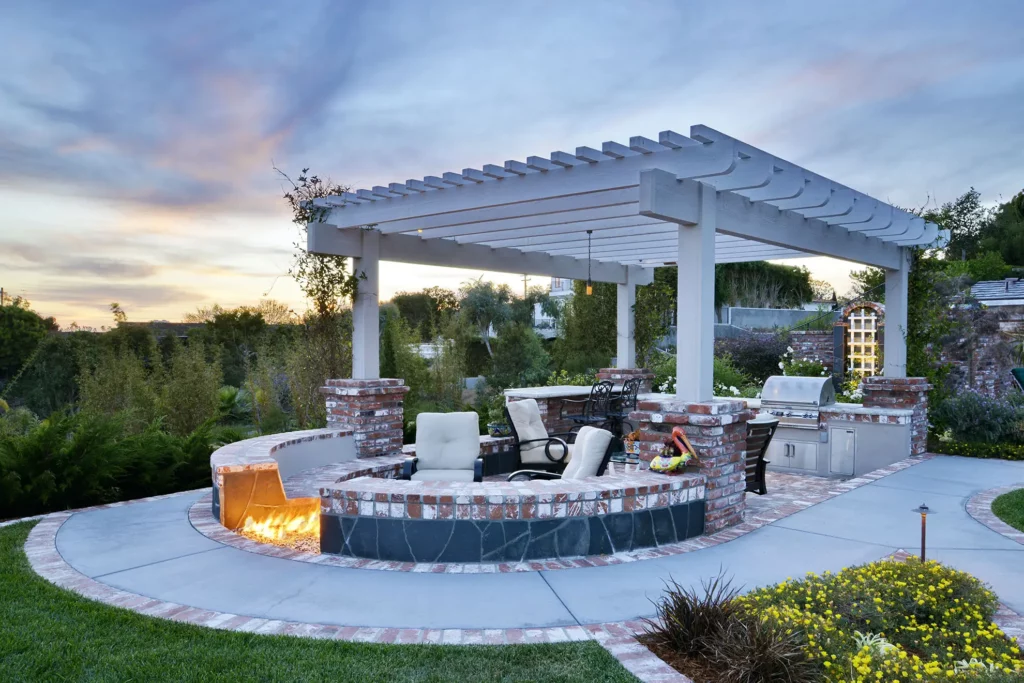
These styles, which dominate the Port Streets and parts of Eastbluff, often work well with either a classic Alumawood lattice or an insulated solid cover that echoes the roofline.
The key is proportionality — these homes have a modest, human-scale quality that an overly dramatic cantilever can overwhelm.
Waterfront properties on Balboa Island and Lido Isle
When lots are compact, and homes are close together, homes often benefit from a motorized louvered system that maximizes the sense of openness when you want it and provides privacy and weather protection when you need it. The app-controlled adjustment is also genuinely useful for homeowners who split time between properties.
This is why we start every Newport Beach project with a design consultation. The right cover for your home isn’t a catalog selection — it’s a decision that starts with your architecture, your HOA, and how you actually use the space.
What Do You Need to Know About Permits and HOA in Newport Beach?
More than most homeowners expect — and this is an area where working with an experienced contractor makes a real difference.
Standard building permit
Required for any patio cover installation in Newport Beach. No exceptions.
Attached covers, solid roof structures, and motorized louvered roofs all require structural review. Motorized systems also require electrical review. This is consistent with most California cities.
Coastal Development Permit (CDP)
This is the Newport Beach-specific layer that catches many homeowners off guard. Approximately 47% of Newport Beach’s land area falls within the California Coastal Zone as defined by the Coastal Act of 1976. If your property is in the coastal zone — which includes most of Balboa Peninsula, Balboa Island, Lido Isle, properties along the Back Bay, and significant portions of the city — your patio cover project requires a Coastal Development Permit in addition to the standard building permit.
Since Newport Beach received certification of its Local Coastal Program (LCP) in January 2017, the City now issues most CDPs directly, rather than requiring approval from the state Coastal Commission.
That’s a meaningful improvement in processing time — but it still adds a layer of review, and for properties within 300 feet of the beach or the mean high tide line, Coastal Commission appeals remain possible.
The practical advice: check your property address against the Newport Beach coastal zone map before you start planning, and work with a contractor who knows how to navigate both processes. We handle all permit applications and HOA approvals as part of every project — including CDP applications for coastal zone properties.
HOA requirements
Newport Beach HOAs are active and specific. Communities in Newport Coast — Pelican Hill, Pelican Crest, Crystal Cove — have strict aesthetic standards given the guard-gated, resort-caliber environment.
HOA requirements typically govern approved materials and color palettes, maximum height and setback distances, and restrictions near view corridors and shared open space. Our team’s familiarity with Newport Beach communities means the HOA submission process is something we manage, not something you navigate alone.
What Makes a Custom Patio Cover in Newport Beach Worth the Investment?
Quality covered outdoor spaces consistently return 60–80% of their cost at resale — and in Newport Beach’s outdoor-oriented coastal market, a beautifully executed patio cover doesn’t just add value, it makes the home more competitive in a buyer’s first walk-through.
These are homes where the backyard is often the closing argument.
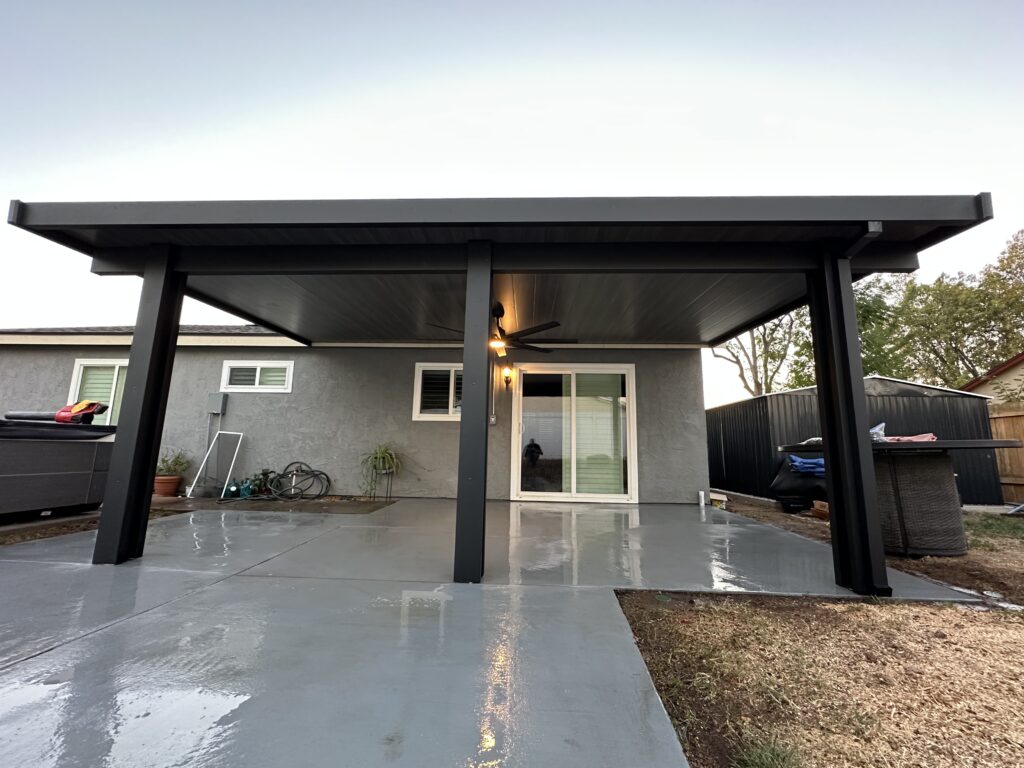
The day-to-day ROI is equally real. Newport Beach’s Mediterranean climate — mild year-round, 280+ sunny days, cool evenings even in summer — means a well-designed outdoor space is genuinely usable 12 months a year. Not just on a warm afternoon, but on a January evening when the rest of the country is frozen, and your covered patio is where you’re having dinner.
There’s also the protection argument. A quality patio cover extends the life of outdoor kitchens, entertainment systems, and furniture that would otherwise take the full brunt of UV exposure and salt air. Replacing high-end outdoor furniture in a coastal environment every few years is a real cost — one that a properly specified cover prevents.
And for homeowners who divide time between Newport Beach and another property — whether that’s Park City, Aspen, or a primary residence in another state — the right cover means arriving to a space that’s ready. No sun damage to assess, no maintenance to schedule before the first dinner party of the season. Just the property at its best.
Ready to Design Your Newport Beach Outdoor Space?
Our team has been designing and installing custom patio covers across Newport Beach, Corona del Mar, Newport Coast, and the greater Orange County coastal market for over two decades.
We understand the architectural variety here, the coastal permitting process, and what it takes to build something that holds up — and looks right — for the long term.
Start with a design consultation. We’ll assess your space, walk through the material and design options that fit your home and HOA, and handle everything from permitting to installation.
Ready to Get Started?
Design Your Custom Newport Beach Patio Cover
Our team handles design, permits, HOA approvals, and installation — start to finish. Schedule your free consultation today.
Schedule Your Design Consultation →Frequently Asked Questions
What patio cover materials are best for Newport Beach’s coastal environment? +
For coastal areas, use premium powder-coated aluminum (like our AAMA 2604-rated 4K Aluminum or Alumawood) because it resists salt, UV, and color loss. Wood and vinyl fail quickly in these conditions. Marine-grade stainless steel fasteners are also crucial.
Do I need a permit for a patio cover in Newport Beach? +
A building permit is required for any patio cover in Newport Beach. In the California Coastal Zone (~47% of the city), a Coastal Development Permit (CDP) is also needed. Newport Beach issues most CDPs directly. Properties near the waterline may require additional Coastal Commission review. Horizon Patios handles both permit processes.
Do Newport Beach HOAs allow custom patio covers? +
Most HOAs, particularly in guard-gated communities like Newport Coast, Pelican Hill, and Crystal Cove, impose strict aesthetic standards (materials, colors, height, setbacks). These rules, governed by CC&Rs under the Davis-Stirling Act, differ by neighborhood. Our team knows Newport Beach HOA requirements and manages the approval submission process for every installation.
What is the difference between 4K aluminum and Alumawood for a Newport Beach home? +
4K Aluminum offers a smooth, modern look with aircraft-grade construction, longer spans, and AAMA 2604 coastal-rated powder coating. Alumawood features an authentic wood-grain texture, better suiting traditional, Mediterranean, or Cape Cod styles. Both aluminum options are durable in Newport Beach’s coastal environment. A full comparison is available at horizonpatiosca.com.
How much does a custom patio cover cost in Newport Beach in 2026? +
Premium 4K Aluminum systems in Orange County cost $15,000–$35,000, varying with size, complexity, and integrated tech. Alumawood and insulated options are also available. With median home values over $3.4 million, covered patios offer a compelling investment, consistently returning 60–80%+ at resale. Contact us for a custom quote.
How do louvered patio covers handle Newport Beach’s coastal wind and winter rain? +
Motorized louvered roofs are ideal for Newport Beach’s coast. Open louvers reduce wind uplift, while closed ones create a watertight roof, channeling rain through internal gutters during the November–March season. Smart home integration and rain sensors enable automatic adjustments. Quality systems feature 4K-grade engineering to handle coastal wind loads.