By the Horizon Patios team · 8 min read
Key Takeaways
- Yes—a patio cover in Beaumont requires a city building permit. It’s not on the city’s exempt list, and attached covers always need one.
- Plan on roughly 3–6 weeks for permit issuance and 30–45 days for HOA architectural review—run them in parallel where you can.
- The San Gorgonio Pass is one of California’s windiest corridors, with gusts documented up to 65 mph; 4K aluminum’s ~120 mph rating is built for it.
- Communities like Tournament Hills, Fairway Canyon, and Solera Oak Valley Greens run active architectural review—get HOA sign-off before the city permit.
- Beaumont is about a 30-minute drive from Palm Springs, well inside our Southern California service area.
Planning a patio cover in Beaumont comes down to three things, but most homeowners think about only one.
There’s the city permit, the HOA architectural review many newer Beaumont communities require, and the San Gorgonio Pass wind that makes your material choice more of an engineering decision than a style preference.
A Beaumont patio cover almost always needs a city building permit – many Pass-area communities add their own HOA approval on top, and the corridor’s sustained wind makes 4K aluminum the structurally smart pick for exposed lots.
It’s a lot to cover, so lets walk through how each piece works, and how a Coachella Valley builder handles a Beaumont project from first visit to final inspection.
We build patio covers across Southern California, and the Pass has its own rules. This is the local-knowledge version we wish every Beaumont homeowner had before signing anything.
Do you need a permit for a patio cover in Beaumont?
Yes. A patio cover in Beaumont requires a city building permit.
Patio covers are not on the City of Beaumont’s list of work exempt from permits, and the city has a dedicated patio-cover permit type in its online portal. Attached covers always need a permit, regardless of size.
California’s residential code does exempt a few small structures – detached sheds under 120 sq ft, fences under 6 feet, certain low decks – but a patio cover with posts and a roof falls outside every one of those exemptions.
The current California Residential Code as adopted by Beaumont governs the build; under it, a patio cover is defined as a one‑story structure no taller than 12 feet with most of one long wall left open.
You can see more on this at the City of Beaumont’s permit page and its work-exempt list are the primary sources.
There are a few additions that trigger their own separate permits – it’s worth knowing before you design:
- Electrical — fans, recessed lighting, or outlets need an electrical permit.
- Gas — a built-in heater or fire feature needs a gas permit.
- Structural attachment — connecting the cover to your house (the ledger connection) is a key inspection point in Southern California’s seismic zone.
How Does The Beaumont Application Work?
The application itself is straightforward and largely online. Here’s the process Beaumont uses:
- Compile your documents as PDFs: building permit application, site plan, architectural plans, structural calcs if required, and Title 24 energy calcs.
- Submit by email to permits@beaumontca.gov or through the city’s CSS online portal.
- Plan review runs 15 business days for the first review and 7 business days for each follow-up review.
- Once approved, the permit is issued and inspections are scheduled through the portal – typically a footing inspection before the concrete pour and a final inspection at completion.
Realistic timeline: about 3–6 weeks from a clean submittal to permit in hand for a residential patio cover in this part of Riverside County.
Pre-engineered aluminum systems with ICC-ES evaluation reports often move through plan check faster. We handle the permit application as part of our service, so this paperwork isn’t something you manage on your own.
What type of patio cover holds up best in the Pass?
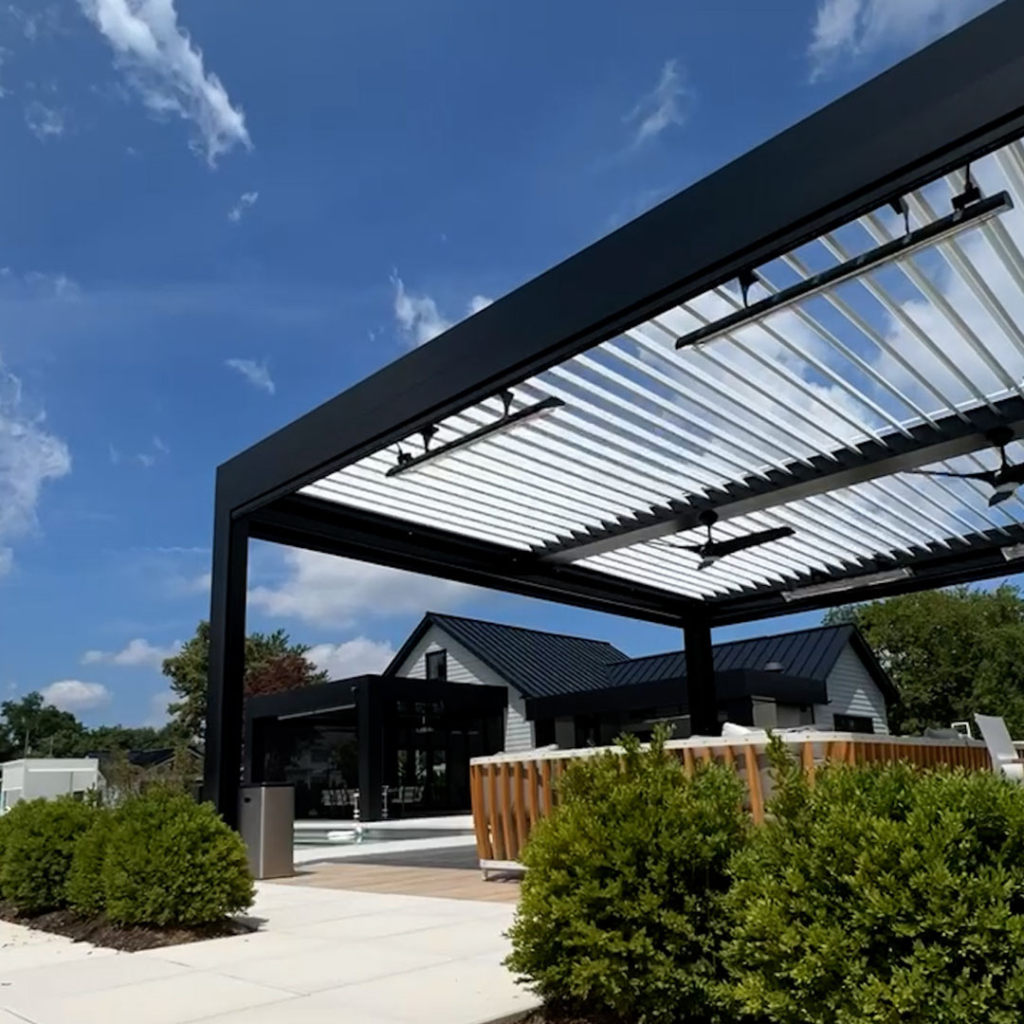
4K aluminum, because of the wind. The San Gorgonio Pass is one of the windiest corridors in Southern California – sustained westerly winds of 30–40 mph are routine, and the Pass saw documented gusts up to 65 mph in a spring 2026 advisory. A heavy-gauge 4K aluminum frame is engineered for wind loads around 120 mph, well above what standard wood-composite systems are built to take.
If you’ve driven I-10 through Beaumont and Banning, you’ve seen the proof: the San Gorgonio Pass wind farm runs hundreds of turbines precisely because the wind here is so consistent.
The Pass is a natural gap between the San Bernardino Mountains to the north and the San Jacinto Mountains to the south, and it funnels air from the high desert toward the Coachella Valley. That venturi effect is exactly why your patio cover needs to be engineered, not just assembled.
This is also where Beaumont differs from the desert floor. At roughly 2,500 feet, the Pass runs cooler than Palm Springs but trades that for steady wind, strong UV, and day-to-night temperature swings that cycle materials hard over the years.
Rigidity matters: a stiffer frame resists deflection, fasteners stay tight, panels don’t rattle loose, and the cover simply lasts longer in an exposed yard. For the site-specific design wind speed your engineer will use, the ASCE 7 Hazard Tool gives the figure for Beaumont’s ZIP (92223).
How does HOA approval work in Beaumont neighborhoods?
Many Beaumont communities require architectural review before you build.
Established neighborhoods like Tournament Hills, Fairway Canyon, and Solera Oak Valley Greens have active HOAs with Architectural Review Committees, and most require a formal submittal for any exterior structural addition. Typical review runs 30–45 days, and HOA approval should come before (or alongside) your city permit.
If your community has an HOA, that approval is its own track with its own rules, separate from the city. Under California’s Davis-Stirling Act, an association can enforce its CC&Rs even when you hold a valid city permit, so skipping the ARC step is a real risk.
You can read our full guide to HOA approvals – it walks you through the documents and the sequence; here’s the short version for Beaumont:
- Pull your CC&Rs and architectural guidelines from the HOA portal and look for the exterior-modification and hardscape sections.
- Note the constraints that drive design: height limits, approved colors, materials, setbacks, and visibility from the street or a golf fairway.
- Submit the ARC package – review form, scaled drawings with setbacks, photos, material and color specs, and the contractor’s license and insurance.
- Get the written approval letter and stamped plans, then include them with your city permit submittal.
Solera Oak Valley Greens is a good example of why this matters: it’s a 55+ Del Webb community of around 1,290 homes with a Design Review Committee, and many of its design-conscious residents would rather have the contractor handle the whole submittal than chase paperwork.
We do – designing to the guidelines from the start so you avoid revision cycles, and preparing and submitting the ARC package as part of the project.
4K aluminum vs. Alumawood – which makes more sense in Beaumont?
For most exposed Pass lots, 4K aluminum is the stronger choice; Alumawood still earns its place on sheltered sites and budget-first projects.
The deciding factor in Beaumont is wind load. Here’s how the two compare on the specs that matter:
| Feature | 4K Aluminum | Alumawood |
| Material | Heavy-gauge extruded aluminum | Roll-formed aluminum, wood-grain finish |
| Wind rating | Up to ~120 mph | ~90 mph (standard) |
| Max span (no interior rafter) | Up to ~20 ft | Shorter; more posts/support |
| Post profile | 6″ post, 3/16″ wall | Thinner, lighter gauge |
| Finish / fade | Smooth modern powder coat; high UV stability | Wood-grain texture; can fade over time |
| Look | Modern, architectural, specialty | Traditional, classic wood look |
| Market price (installed)* | ~$40–$60 / sq ft | ~$22–$45 / sq ft |
| Best fit in the Pass | Exposed lots; design-conscious buyers | Sheltered sites; budget-first projects |
*Prices reflect the general Riverside County market, not a Horizon quote – your number depends on size, attachment, finish, and site conditions.
The takeaway lines up with our deeper 4K aluminum vs. Alumawood comparison: Alumawood is a genuinely good, lower-cost cover that performs well on protected patios.
But on an open lot in the Pass, 4K’s extruded frame, longer clear spans, and modern finish are worth the difference – especially for the design-minded buyers searching for specialty and modern covers in Beaumont. If your yard is sheltered and budget leads, Alumawood is still a smart call.
What does installation process look like from start to finish?
A Beaumont patio cover typically runs 8–14 weeks from first consultation to final inspection, with HOA review and permit plan-check overlapping to save time.
Beaumont is well within our service area: it’s about 29 miles from Palm Springs, roughly a 30-minute drive west on I-10, a route we travel regularly.
Here’s the full arc of a project:
- Consultation and design — an on-site visit, measurements, and material selection (1–2 weeks).
- HOA submittal, if your community requires it — we prepare and submit the ARC package (30–45 days review).
- Permit application — plans go to the City of Beaumont (15 business days for first review).
- Fabrication — your custom aluminum components are built (1–3 weeks).
- Installation — footings, posts, beams, roofing, and any electrical (1–5 days on site).
- Inspections and closeout — footing and final inspections, scheduled through the city portal.
On your end, the lift is light: share your HOA documents if you have them, your property survey or site plan if it’s handy, and backyard access for the site visit. We coordinate the rest.
When you’re ready, you can start your project with a single consultation, and we’ll map the timeline to your community’s specific requirements.
Why are homeowners across the Pass choosing Horizon Patios?
Because we bring two decades of patio-structure experience to a market that rewards doing it right.
Horizon Patios is a family-owned company with over 20 years of experience, recognized as one of California’s top five builders for patio structures – and we treat permits and HOA approvals as part of the job, not an add-on.
For Beaumont specifically, that experience translates into a few things that matter: covers engineered for Pass wind rather than generic shade, design work tuned to the specialty and modern looks buyers here are actually searching for, and a process built to clear architectural review the first time.
Our premium aluminum covers – both 4K and Alumawood – carry lifetime warranties against defects and a lifespan of 30+ years. You can see the range of finished work in our project gallery, and our guide on how to choose the best patio cover company lays out the licensing and credentials worth checking on any builder.
A quality cover also pays you back. The same logic in our breakdown of how a patio cover increases home value applies across the Pass: shade structures are one of the most reliable outdoor improvements for usable space and resale appeal in a hot-summer market.
Start Your Beaumont Patio Cover Project
If you’re weighing a patio cover in Beaumont, Calimesa, or anywhere along the Pass, we’ll help you sort the permit, the HOA, and the right material in one conversation. No pressure, just a clear plan.
Start your project, and we’ll take it from there.
You can also browse more outdoor living guides or explore our full range of outdoor living solutions.
Frequently Asked Questions
Do you need a permit for a patio cover in Beaumont?
Yes. A patio cover requires a City of Beaumont building permit.
Attached covers are treated as structures and require a permit under the city’s current guidelines. Adding electrical, gas, or structural attachments to the house requires separate permits. Plan on roughly 3–6 weeks from a clean submittal to permit issuance.
What is the best patio cover material for Beaumont’s wind?
4K aluminum, because the San Gorgonio Pass sees sustained 30–40 mph winds and gusts documented up to 65 mph. Its heavy-gauge extruded frame is engineered for roughly 120 mph wind loads, so it resists deflection and stays tight far better than thinner wood-composite systems on an exposed lot.
How long does HOA approval take in Beaumont communities?
Most Beaumont HOAs with architectural review take about 30–45 days. The contractor usually prepares and submits the package, and it’s best to run it before or alongside your city permit. Communities like Tournament Hills, Fairway Canyon, and Solera Oak Valley Greens all have active architectural review.
How much does a patio cover cost in Beaumont?
It depends on size, material, attachment, and finish. In the Riverside County market, Alumawood typically runs about $22–$45 per square foot installed, and 4K aluminum about $40–$60 per square foot installed, with permits and engineering adding several hundred dollars. The most accurate number comes from an on-site measurement.
Does Horizon Patios serve Beaumont and the Pass area?
Yes. Beaumont is about 29 miles from Palm Springs – roughly a 30-minute drive on I-10 – and sits inside our Southern California service area. We travel the Pass corridor regularly and handle scheduling, site visits, and warranty service across the region.
4K aluminum or Alumawood for Beaumont?
Choose 4K aluminum for exposed lots and a modern look – its wind rating and longer spans suit the Pass. Choose Alumawood for sheltered patios or budget-first projects where it still performs well. Wind exposure on your specific lot is the deciding factor.