Key Takeaways
- The things you’ll notice first — fading, dust, or a tired-looking finish — are almost always cosmetic. What matters is what you can’t see.
- Palm Springs hit 110°F or hotter on 38 days through August — while that’s an ordinary desert summer, your cover spent all of it in a materials stress test.
- Blocked drainage is the one item here that gets worse on its own. Water that can’t leave a cover heads for the ledger, and the ledger is attached to your house.
- Most property-management agreements cover locks, pool chemistry, HVAC, and irrigation. A structural look at a patio cover generally isn’t in that scope.
- If a repair needs HOA or city sign-off, September is the honest cutoff for an October arrival. Straightforward fixes have more runway.
You locked up in May and hit the road to avoid the hottest part of the year.
But your house has sat in triple-digit heat for four months with nobody in it. Now you’re a few weeks from coming back and near the bottom of your mental list?
“How’s the patio holding up?”
We do this walk with homeowners in Rancho Mirage, Palm Springs, and across the valley this time of year – and we notice that most people point at what looks different and ignore what matters (and could cost you more in the long run).
Here’s how to tell them apart from two thousand miles away.
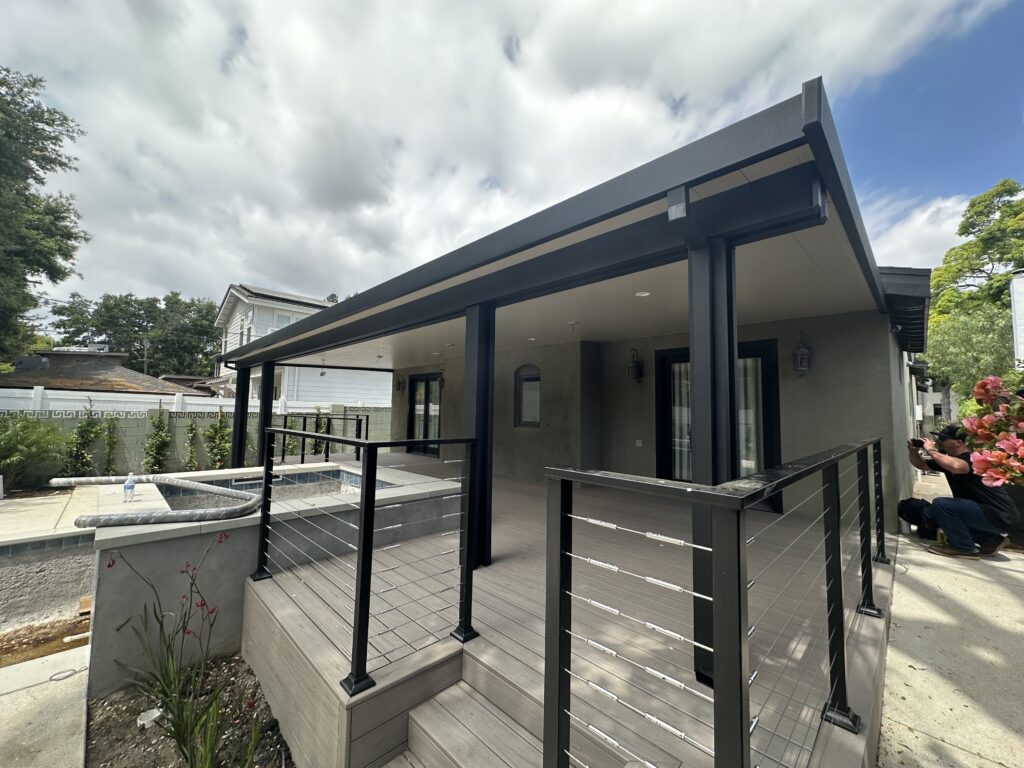
What does a desert summer do to a patio cover?
Your home’s patio undergoes the same test every year — extreme heat, hard sun, wind-driven dust, then sudden water. And while most modern patio materials can shrug off any one of those, too much of anything is a bad thing.
Palm Springs hit 110°F or higher on 38 days through August 31, against 42 in 2025 and 83 in 2024.
So at a glance, it can seem like this summer landed on the mild end. But the reality for your patio is the same regardless of the number of days: even a normal desert summer still means five or six weeks above 110.
We’ve written before on why a covered patio can still feel like an oven and what it takes to cool one at 120°F – so you know just how intense this kind of weather can be.
Then there’s the fact that water arrives on its own schedule. Around these parts, monsoon season runs from roughly June 15 through September 30. That means the wind/dust and the downpours all land in the months your house sits closed.
Don’t forget that the San Gorgonio Pass is one of the most consistently windy places in the country, and Palm Springs and Cathedral City feel that in a way Rancho Mirage and Indian Wells don’t.
What should I look at first?
First, sort what you find into three buckets. You’ll find that nearly everything lands in bucket one, which keeps you from spending October on a non-problem.
| Tier | What it looks like | What to do about it |
|---|---|---|
| Cosmetic Leave it | Even, all-over softening of color. Dust film on the beams. Grit on the deck. A little chalkiness on older powder coat. | Nothing structural. Add a wash to the pre-arrival cleaning list and enjoy the shade. |
| Watch it Photograph and date it | Patchy rather than even fading. A fastener head standing proud. Hairline gaps at a post base. A rattle somebody mentions on a windy day. | Have whoever is on site send date-stamped photos to your contractor, then look again in 30 days. This tier needs a person there — line that up now. |
| Call now Before you arrive | Any sag or dip in a beam line. A post shifted at its base. Water staining on the house wall behind the ledger. Standing water or dried marks after a storm. A gutter or scupper packed solid. Loose panels. | Get qualified eyes on it this month, not the week you land. If the fix needs HOA or city sign-off, the calendar is tighter than it looks. |
It’s the same triage we run when a homeowner sends photos in July, and why we can usually say “that can wait.” Our project gallery shows the work behind that judgment.
Is fading a problem, or just “how it looks now”?
Generally, all-over fading is expected and isn’t a defect. Nearly every custom patio cover will take on a look of its own based on your home and property.
Patchy fading is worth a photograph and a question — not because patchiness proves anything, but because it’s worth a look rather than a guess.
Architectural finishes get tested for this. A coating certified to AAMA 2604 has come through five years of South Florida exposure, still holding at least 30 percent of its original gloss; AAMA 2605 runs ten years and retains at least 50 percent. Gloss and color are scored separately, so a finish can dull slightly while its color stays put.
A quality finish is engineered to change slowly and evenly, so one summer shouldn’t move the needle much.
If yours looks dramatically different from what it did in May, that’s worth a conversation. Our recent comparison of 4K aluminum and Alumawood covers why finish quality varies so widely between products that look identical in a brochure.
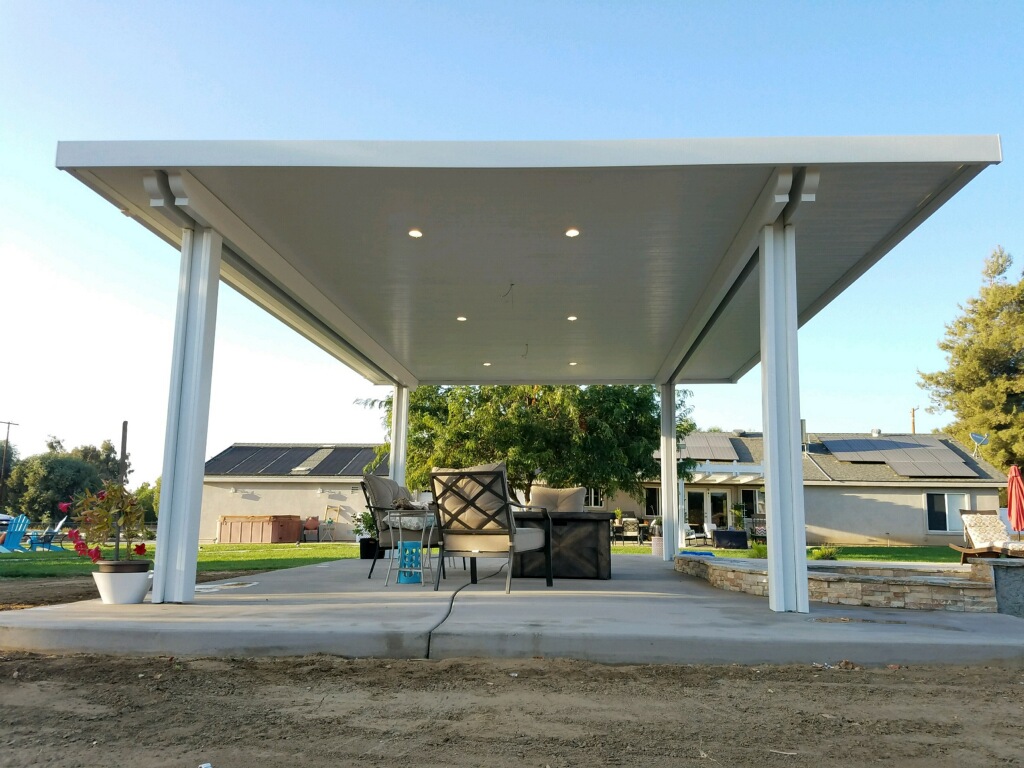
Why does the hardware loosen throughout the summer?
Remember your science: metal grows when it heats and shrinks when it cools, and aluminum does both even more dramatically than other building materials.
So in this heat, your cover has been doing that daily since May.
Aluminum expands at roughly 13.1 millionths of an inch per inch per degree Fahrenheit, against about 7.8 for carbon steel. You can say it’s about 68% more movement per degree.
13.1 millionths of an inch doesn’t sound like much. But run that across a twenty-foot beam and a 75-degree swing between a January night and a July afternoon, and you get about a quarter inch of growth and retreat.
So, while you’ll never see it happen, you will see the result years later.
Well-built assemblies accommodate that movement instead of fighting it, which is much of what separates a cover that ages well from one that starts talking to you in the wind. A beam in direct sun also runs hotter than the air around it, so real movement exceeds that quarter inch.
What’s hiding in the drainage and along the roofline?
Blowing dust plus sudden monsoon rain packs sediment into gutters, scuppers and downspouts, and that blockage never announces itself. Of everything here, it’s what we’d check first.
Water that can’t leave has to go somewhere, and usually it backs toward the ledger — the connection between cover and house — and sits.
Staining on the wall behind it is the visible symptom, and by the time that shows, water has been going the wrong way for a while.
But debris doesn’t arrive just from the sky. Overhanging trees, shifting decomposed granite, and irrigation spray all contribute, which is why planting choices around a covered patio matter more here than almost anywhere.
What can my property manager check, and what can’t they?
Most property-management agreements cover locks, pool chemistry, HVAC, irrigation, and the interior; structural assessment of an outdoor structure usually sits outside that.
That’s no knock on your manager — nobody hired them to evaluate architectural things like beam deflection, and they’d be right to say so. What they can do easily is document. Forward them this list as-is:
- Photograph each beam line from underneath at both ends, so any dip shows against a straight edge in frame.
- Photograph the ledger where the cover meets the house and the wall beneath it.
- Photograph the base of every post at ground level.
- Photograph what’s inside the gutters and scuppers.
- Note anything that moves, rattles, or sounds different in the wind.
Date-stamped photos of those five things tell a contractor most of what they need to know and take about fifteen minutes. That’s the difference between arriving informed and arriving surprised.
If something needs fixing, is there still time before season?
For straightforward repairs, there’s usually time to get it done. But if anything needs HOA or city review, September may be the cutoff if you’re arriving in October.
For instance, Palm Springs commits to a 30-calendar-day plan review cycle for single-family permits, and a resubmittal restarts that clock. Palm Desert publishes 10 to 15 working days for initial review, though that figure is posted for commercial work — ask your plans examiner about residential.
The HOA layer runs on its own schedule and is most likely to surprise you. Davis-Stirling requires a written decision but sets no deadline for one, so your community’s governing documents control the pace.
PGA West’s architectural review committee meets monthly — one named example, not a universal rule; yours may meet more or less often.
Not sure what you’re looking at? Send us a photo.
Send what you’ve got — a few photos from your property manager, or a description of whatever’s nagging you — and we’ll tell you which bucket it’s in. If it’s cosmetic, we’ll say so.
If it needs attention before you land, you’ll know while there’s still room to act. Start your project today, or read more about our patio covers and the rest of our outdoor living solutions.
Frequently Asked Questions
How long should an aluminum patio cover last in the desert?
A well-built aluminum cover with a quality architectural finish is a multi-decade structure. Heat and sun shorten a finish’s cosmetic life faster here than on the coast, but they don’t meaningfully shorten the structural life of properly engineered aluminum.
Is it normal for a patio cover to fade after one summer?
A slight, even softening of color over a summer is normal here. A dramatic change after one season, or patchy rather than uniform fading, is worth photographing and asking about. Even fade is aging; uneven fade is a question.
What maintenance does a patio cover need after monsoon season?
Clear the gutters, scuppers and downspouts first — packed dust is the most common post-monsoon issue and the one with real consequences. Rinse the structure down and give fasteners and post bases a once-over. If you’ve got a misting system on the cover, its nozzles need their own seasonal service.
Can I have my patio cover looked at while I’m out of state?
Yes — a remote assessment starts with photographs, which is why the five-photo list above is worth forwarding to whoever is on your property. From those we can usually tell whether something needs a site visit or can wait. Reach out through Start Your Project and we’ll walk you through what we need.
What happens if I wait until I’m back in October to deal with a problem?
Straightforward repairs are generally still workable in October. Anything needing HOA review or a city permit is where waiting hurts, because those timelines run on committee calendars and plan-check queues, not yours.