Key Takeaways
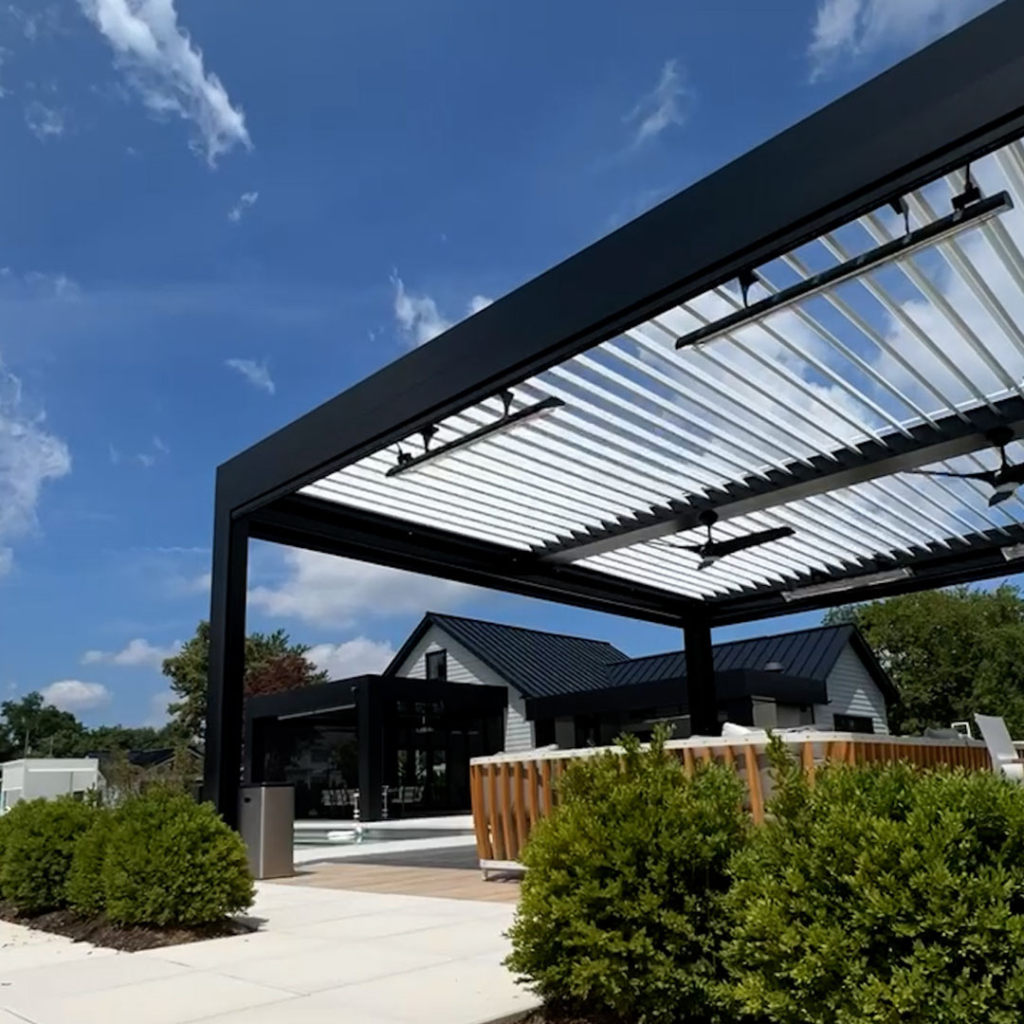
- A motorized louvered roof is an adjustable aluminum roof whose blades rotate from fully closed to fully open — typically across a 130° to 180° arc — giving you sun, shade, and airflow at the touch of a button.
- Fully closed, the interlocking louvers form a weather-resistant roof, and an integrated gutter system channels rain down through the support posts rather than onto your patio.
- In real desert-climate heat testing, a louvered roof shed 28–29°F of surface heat after sunset and remained cooler than the surrounding open air.
- Expect to invest roughly $100–$160 per square foot installed in the Coachella Valley — about $19,000–$31,000 for a 12-by-16-foot space — before smart-home and sensor add-ons.
- Most Coachella Valley HOAs treat a louvered roof like any other patio cover, so the approval process is the same as for a solid cover.
Everyone wants that perfect space to dine outside. And in Rancho Mirage, the weather is ideal for most of the year for hosting friends and family on the back porch.
But when the California sun is high in the sky in July, you’re faced with a choice: find suitable shade or retreat inside to avoid the 112° heat.
What if you could have shade or sun – anytime you wish? At the tap of an app or a spoken command, a motorized louvered roof’s aluminum blades rotate from fully open to fully closed — giving you sun, shade, ventilation, and rain protection on demand.
For the homeowner who has already invested in the home, the pool, and the view, this upgrade finally makes the outdoor room as controllable as the rooms inside.
What is a motorized louvered roof?
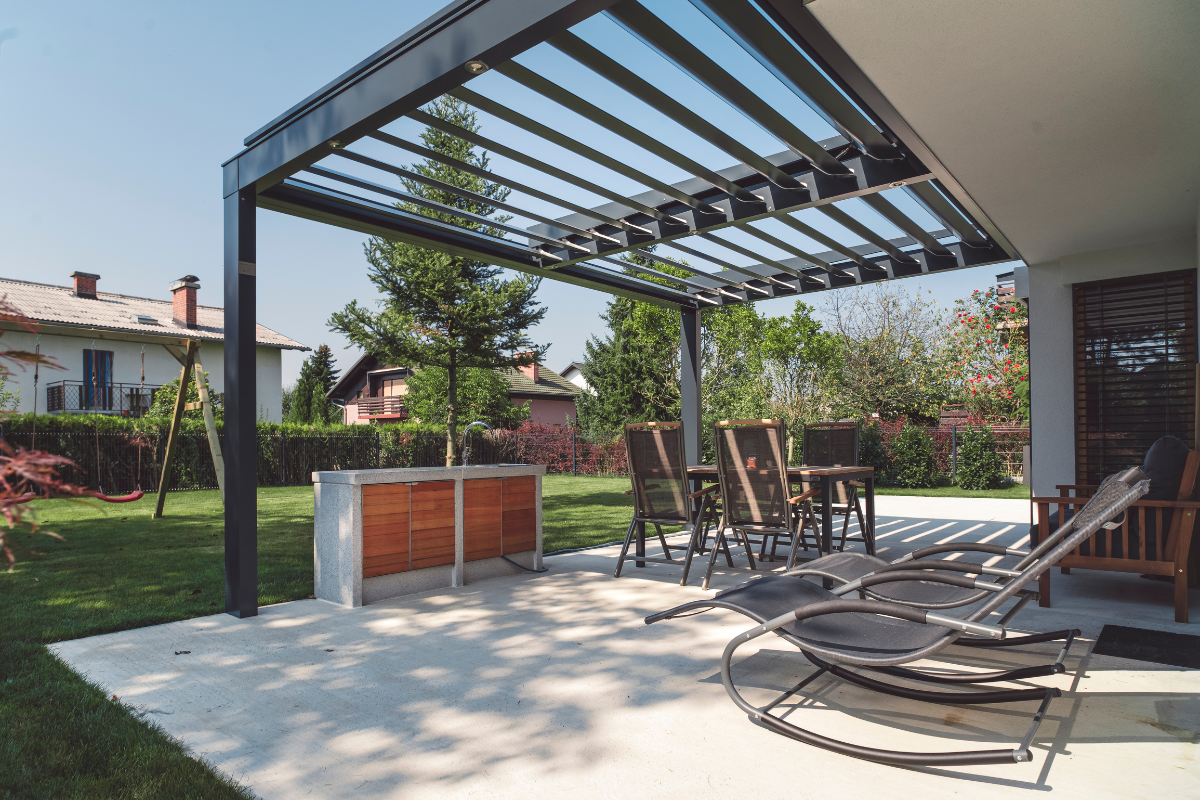
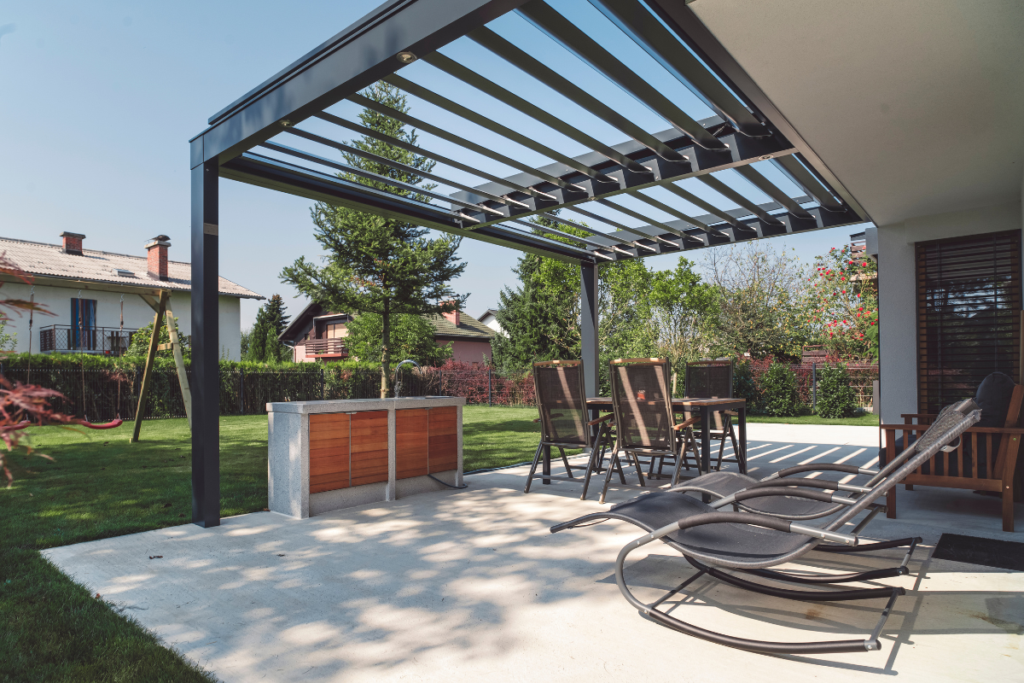
A motorized louvered roof is a permanent aluminum structure with rotating roof blades — called louvers — that pivot in unison to open the roof to the sky or close it into a solid surface.
It works by utilizing a small, high-torque electric motor that turns a linkage bar connecting the louvers, so the entire roof opens or closes in a single smooth motion and pauses at any angle in between.
But not all systems are created equal. The best motorized louvered systems are built from structural-grade aluminum that meets the ASTM B221 standard for extruded aluminum (typically 6063-T6 alloy). This is the same architectural-grade material specification used in premium building products.
And that matters in the desert, where the structure has to handle decades of intense sun and thermal expansion without warping.
For a standard residential span, a single beam of louvers is driven by a single motor, and a support post is generally required when the clear span exceeds about 14 feet.
The result is a clean, modern structure that reads as architecture rather than an add-on — which is exactly why it pairs so well with the kind of luxury patio covers and integrated outdoor living solutions our clients expect.
How does a louvered roof handle the Coachella Valley’s extreme heat and other weather conditions?
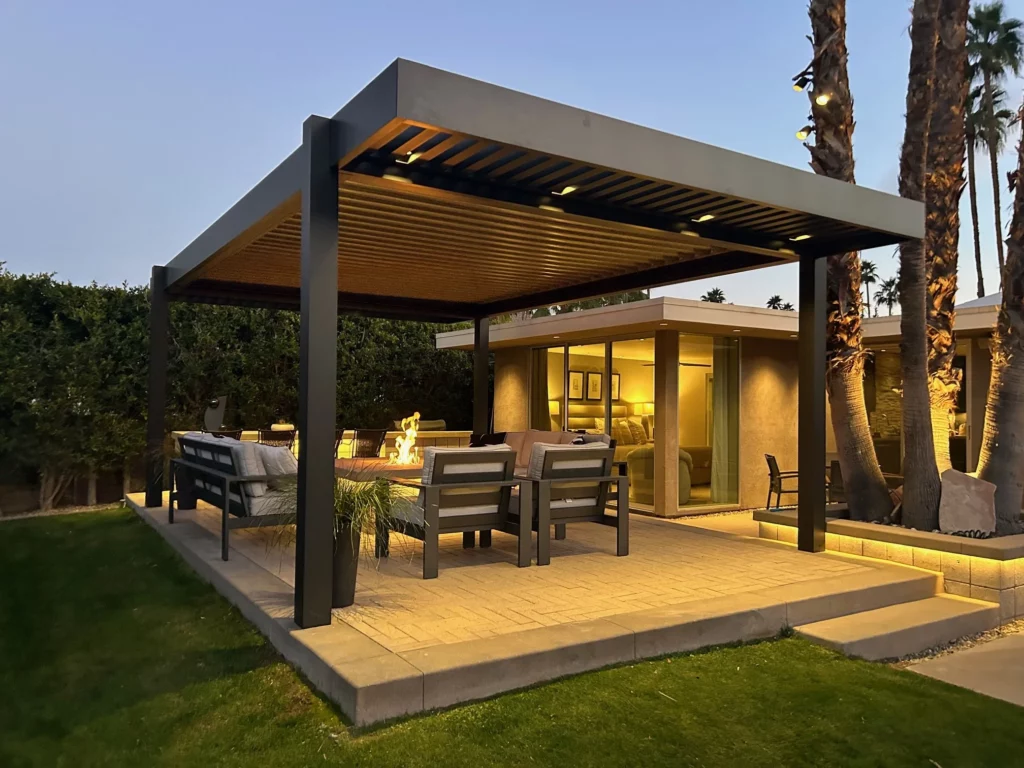
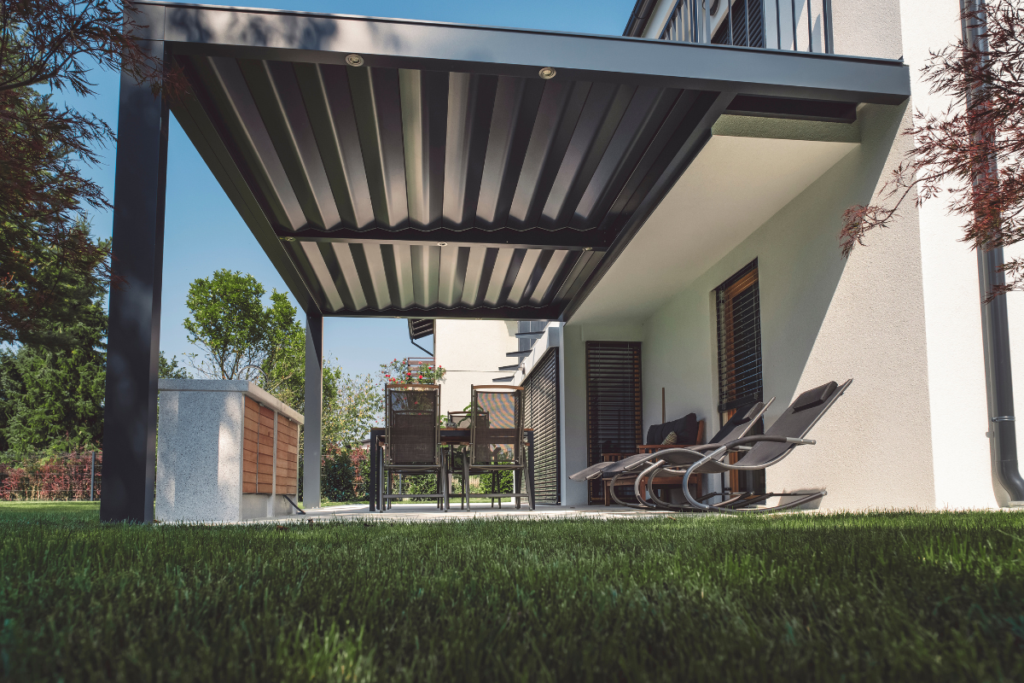
Here is the part most homeowners do not realize: fully closed, the louvers interlock to form a weather-resistant roof.
Built-in gutters in the perimeter beams capture rainwater and channel it down through the hollow posts, keeping your space dry. It is not technically “waterproof” in an absolute sense — but a well-designed system is highly weather-resistant and actively manages water rather than just shedding it.
Fully closed, a louvered roof delivers 100% shade regardless of where the sun sits — it functions as a solid roof in that position. The advantage over a fixed cover is what happens the rest of the day: you can angle the louvers to block direct sun while still letting hot air rise and escape through the gaps, rather than trapping it underneath.
And how well does it perform? In real-world desert-climate heat testing, a louvered roof surface dropped 28–29°F after sunset — compared with only 20–21°F for a traditional insulated roof — and the space beneath it remained cooler than the ambient air around it.
At peak sun, angling the louvers to block direct light while preserving airflow can reduce the temperature beneath the structure by roughly 10–15°F.
For the longevity that desert UV demands, the finish matters as much as the metal. A reputable installer specifies a powder coat that meets the AAMA 2604 or 2605 architectural standard — the benchmark for color and gloss retention under aggressive sun exposure.
Pair a louvered roof with a misting system, and you have a genuinely all-season outdoor room — shade and airflow overhead, evaporative cooling at seating level. (We cover that combination in depth in our guide to desert misting systems.)
How does a louvered roof compare to a solid aluminum patio cover?
A solid patio cover is always “on” — full shade, full rain protection, no sun. While a louvered system lets you choose wide-open sky for a January morning, full shade for a July afternoon, and everything in between.
The real difference shows up in price. A solid 4K aluminum cover typically runs $40–$60 per square foot installed, while a motorized louvered system runs closer to $100–$160 per square foot — roughly 2.5-3 times the cost for the same footprint.
You are paying for the motors, the engineering, and the control. If you are still weighing materials at the cover level, our breakdown of 4K aluminum versus Alumawood is the right place to start.
In some cases, a solid cover is sometimes the smarter call. If budget is the deciding factor, a quality 4K cover delivers more at a lower price point than an entry-level louvered system.
If the space exists purely for shade and rain protection — a covered outdoor kitchen that is always in use, say — the adjustability buys you little. Some older communities also restrict finishes in ways that limit louvered options.
But if you entertain, if you value open sky as much as shade, or if you want one outdoor space that adapts to every season and every hour, the louvered premium earns its keep.
Can a motorized louvered roof connect to a smart home system?
It can – and that’s one of the best benefits of this kind of system.
A modern motorized louvered roof integrates with the major smart-home platforms — including Amazon Alexa and Google Assistant for voice control, and professional systems like Control4 and Crestron for whole-home automation.
Integrations
Integration runs through a small bridge device that translates the system’s radio signal to your home Wi-Fi; it is not a direct Wi-Fi connection, so a hub is part of any smart setup.
From the companion app, you can open or close the roof, set the louvers to a saved angle, schedule positions by time of day, and build scenes — a “morning coffee” scene at 25% with warm lighting, an “evening entertainment” scene fully open with the LEDs up.
Larger installations can run up to four independent zones and sixteen motors, so different sections of a big patio move on their own.
Sensors
A rain sensor triggers the louvers to close at first contact with moisture — no waiting for accumulation — and the wind sensor opens them in high gusts to protect the structure.
For our many seasonal and second-home clients, that means the system protects the patio whether you are home in the desert or away at your coastal property.
This is also where a louvered roof becomes the anchor of a fully integrated outdoor space — coordinated with hardscapes, landscape lighting, and cooling, all designed together rather than bolted on one at a time.
What does a motorized louvered roof cost in the Coachella Valley?
A professionally installed, premium motorized louvered roof in the Coachella Valley generally runs $100–$160 per square foot, including permits and basic smart controls.
For the most common “starter luxury” footprint — a 12-by-16-foot space sized for a dining table and seating — that works out to roughly $19,000–$31,000. Larger or highly customized builds climb past $50,000.
Five things move the number:
- Square footage (the dominant driver)
- The required number of motors and zones
- The smart-home and sensor package (often $800–$2,000)
- Custom powder-coat colors
- Whether the system is attached to the home or freestanding — freestanding adds 20–30% because it needs its own footings and posts
This is a meaningful investment, but a durable one. A louvered roof extends usable outdoor living across far more of the year and adds the kind of architectural feature buyers notice — the same dynamic we detail in seven ways a luxury patio cover increases your home’s value.
The best way to get a real number is a design consultation, where we measure the space and price the system you actually want. It is also worth planning the entire outdoor room at once — our guide to planning a luxury outdoor living project walks you through thinking in zones before you build.
Will my HOA approve a motorized louvered roof?
In most Coachella Valley communities, yes — architectural committees generally classify a motorized louvered roof the same way they classify any other permanent patio cover, which means it goes through the standard architectural-review process rather than a special one.
That process typically takes 30 to 45 days in most CV communities, and the submission usually calls for scaled drawings, material and color samples, and structural details.
We cover the full process — and how to avoid the common delays — in our guide to HOA approvals for luxury outdoor upgrades. A practical tip from that guide: submit before the spring and summer building rush, when review backlogs are longest.
Here is the part that matters most for your sanity: you do not have to manage any of it. Horizon Patios handles both the HOA submission and the city permit on your behalf, in the correct order, whether you are managing a primary residence in Palm Springs, Palm Desert, or anywhere in the communities we serve.
It is part of how we have worked for more than two decades.
Ready to See What a Louvered Roof Could Look Like on Your Home?
Every project starts with a design consultation — we visit your home, measure the space, and show you exactly how a motorized louvered roof would work with your architecture, your sun exposure, and your lifestyle.
Start your project and let’s design an outdoor room that opens to the sky and closes out the heat, on your command.
Frequently Asked Questions
What’s the difference between Equinox and Elitewood louvered roof systems?
Both are well-known aluminum patio cover brands, but they serve different needs. Equinox is a dedicated motorized louvered roof system, backed by a 20-year limited warranty on the louvers, beams, and posts. Elitewood is a broader line of aluminum patio covers — including solid and lattice styles — better known for fixed covers than for motorized louvers. The right choice depends on whether adjustability is your priority.
How much wind can a motorized louvered roof withstand?
Premium systems are engineered for wind ratings between 90 and 150 mph, depending on the model and installation, with some carrying independent structural certification. As a safeguard, the wind sensor automatically opens the louvers at around 60 mph, so gusts pass through rather than pushing against a closed roof — an important feature in the windy San Gorgonio Pass corridor.
Do motorized louvered roofs require much maintenance in the desert?
Very little. Rinse the louvers with a garden hose monthly to clear windblown dust and sand, keep the perimeter gutters clear, and schedule a professional inspection and lubrication once a year (typically $150–$250, and good for preserving the warranty). Avoid high-pressure washing, which can damage the pivot mechanisms and motor seals.
Are motorized louvered roofs actually waterproof?
They are highly weather-resistant rather than absolutely waterproof. When the louvers close, they interlock to form a tight roof, and an integrated gutter system in the beams channels rainwater down through the hollow posts. For everyday Coachella Valley rain, a quality closed system keeps the space dry.
Can a louvered roof be added to an existing patio?
Yes. A louvered roof can be attached to the home over an existing patio slab or built as a freestanding structure. Freestanding versions need their own footings and a full set of posts, which adds roughly 20–30% to the cost. A site assessment confirms what your specific space and foundation can support.
What kind of warranty comes with a motorized louvered roof?
Coverage varies by manufacturer, but the typical structure is a 15–20-year limited warranty on the aluminum frame and louvers, around 5 years on the motor and electronics, and roughly 10 years on the powder-coat finish. The aluminum structure itself is often described as a 25-plus-year asset, with motors as the serviceable component over time.