Key Takeaways
- High-pressure systems operate at 800–1,200 PSI and produce 5–20 micron droplets that flash-evaporate in mid-air. Low-pressure systems run on standard household tap pressure (40–60 PSI) and produce visible droplets that wet surfaces.
- In California’s dry inland and desert climates, high-pressure systems drop ambient temperatures by 20–30°F. Low-pressure tops out around 15–20°F and loses effectiveness quickly as humidity rises.
- High-pressure uses 1–2 gallons per hour per nozzle. Low-pressure uses 4–5 gallons per hour — making high-pressure 2–3x more water-efficient at the same coverage.
- Professional installation is required for true high-pressure systems. Low-pressure DIY kits start at $30 but perform accordingly.
- For the Coachella Valley, Inland Empire, and most California inland climates, high-pressure is the clear choice for any permanent outdoor installation.
You’ve already decided you want a misting system. Smart call!
Now you’re trying to figure out which type of system is right for your home — and whether the jump from a kit at the hardware store to a professional installation is worth it the investment.
We’ve spent years installing misting systems across the Coachella Valley and Southern California, and we’ll give you the straight answer: the difference is physics, not branding.
Let’s take a closer look and compare high vs low pressure misting options – and how you can make the right call for your California patio.
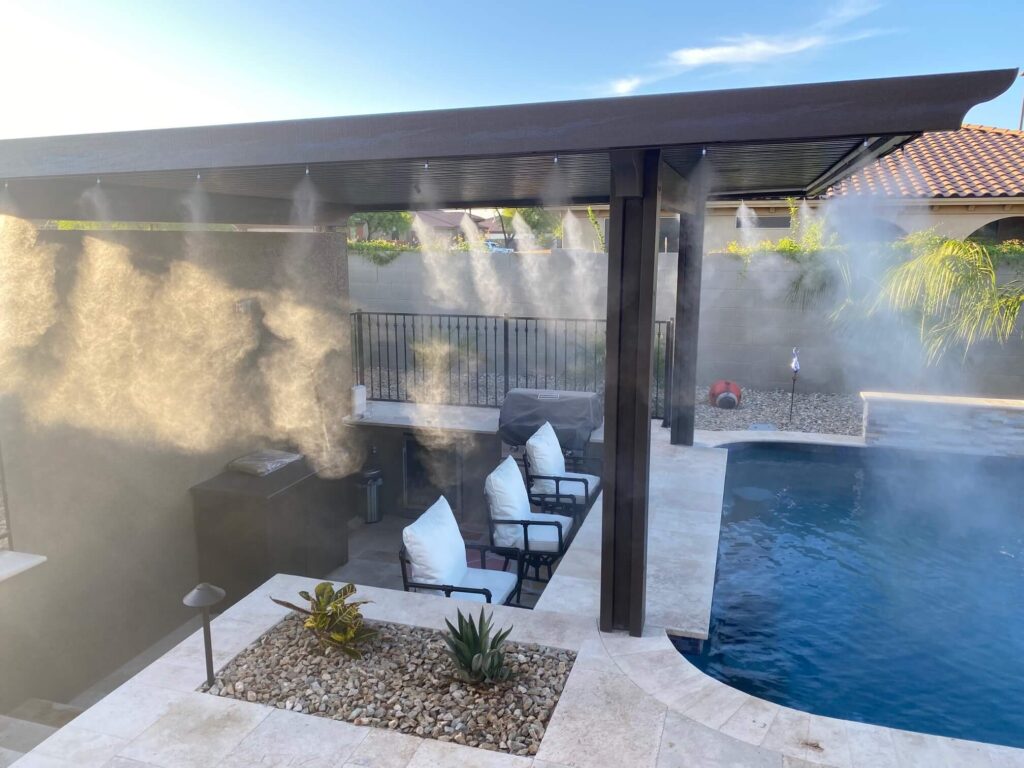
What’s the difference between high-pressure and low-pressure misting?
The short version: pressure determines droplet size, and droplet size determines whether you get real cooling or just get wet.
Low-Pressure Misting Systems
A low-pressure system runs directly off your household water line — the same 40–60 PSI that flows out of your garden hose. Push that through small-orifice nozzles, and you get a visible spray of relatively large droplets (100–500+ microns).
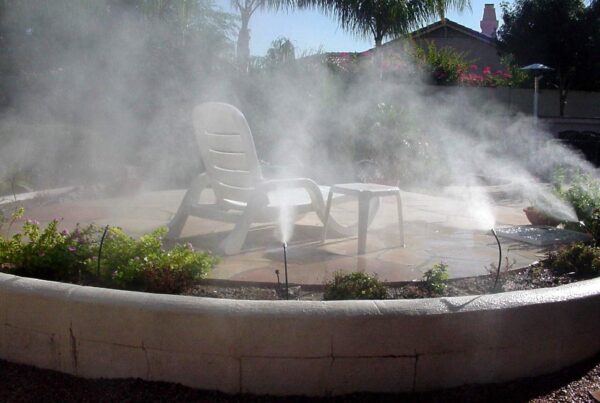
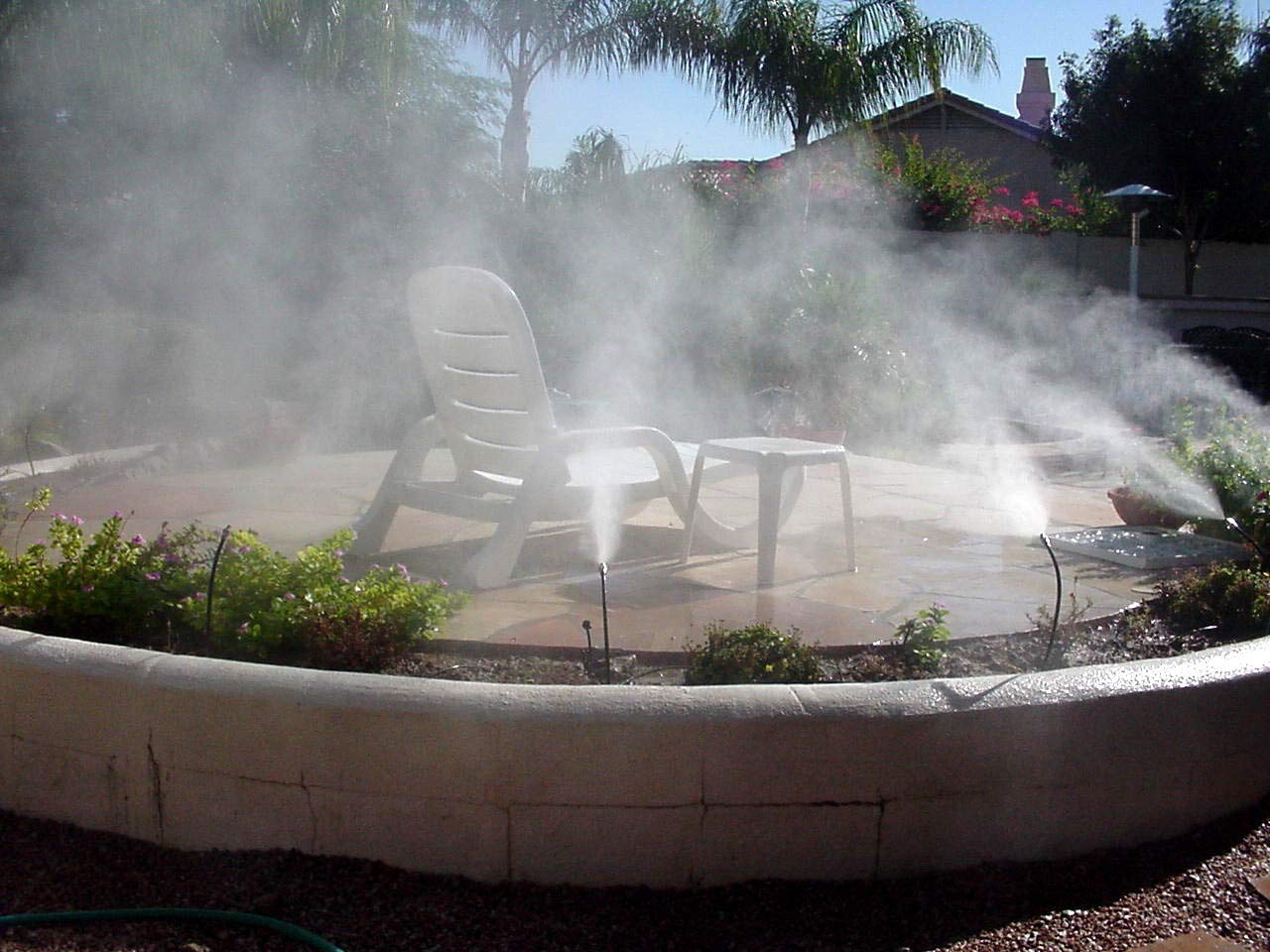
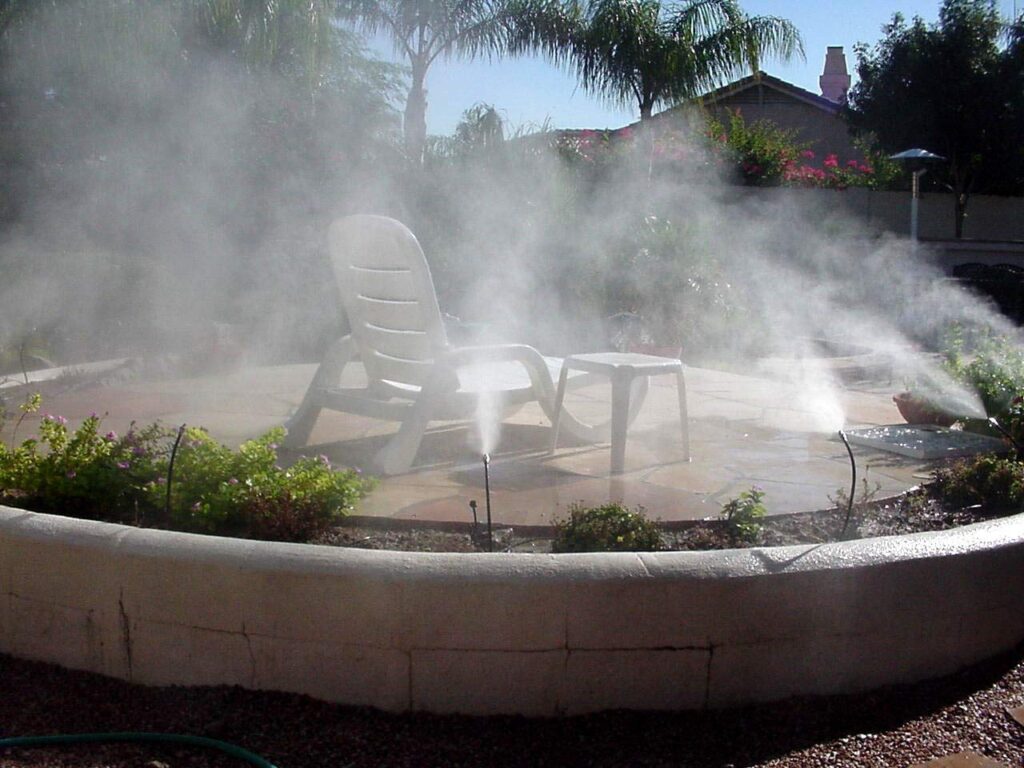
Those droplets are too heavy to fully evaporate before hitting surfaces, so you cool down partly by evaporation and partly by being lightly misted — uncomfortable near furniture, electronics, or an outdoor kitchen.
High-Pressure Misting Systems
A high-pressure system uses a dedicated pump to reach 800–1,200 PSI — roughly 17 to 25 times the pressure of your tap.
At that pressure, nozzles produce droplets of just 5–20 microns. Those particles are essentially invisible, remain suspended in the air, and flash-evaporate before reaching ground level. The cooling happens in the air above you, not on you.
This is evaporative cooling working as it’s supposed to. When microscopic water particles evaporate, they absorb latent heat from surrounding air. The smaller the droplet, the greater the surface-area-to-volume ratio, and the faster the evaporation.
Properly sized nozzles at 1,000 PSI produce droplets with a mean diameter of 12–15 microns — small enough to flash-evaporate in dry California air almost instantly. We cover the full mechanics in our complete guide to misting systems if you want to go deeper on the science.
There’s also a middle tier worth knowing: mid-pressure systems with booster pumps that reach 150–300 PSI. Better than tap pressure, less surface wetting, and available for $200–$1,500 installed.
They’re a reasonable option for smaller patios in moderate climates, but don’t deliver the performance of true high-pressure in California’s heat.
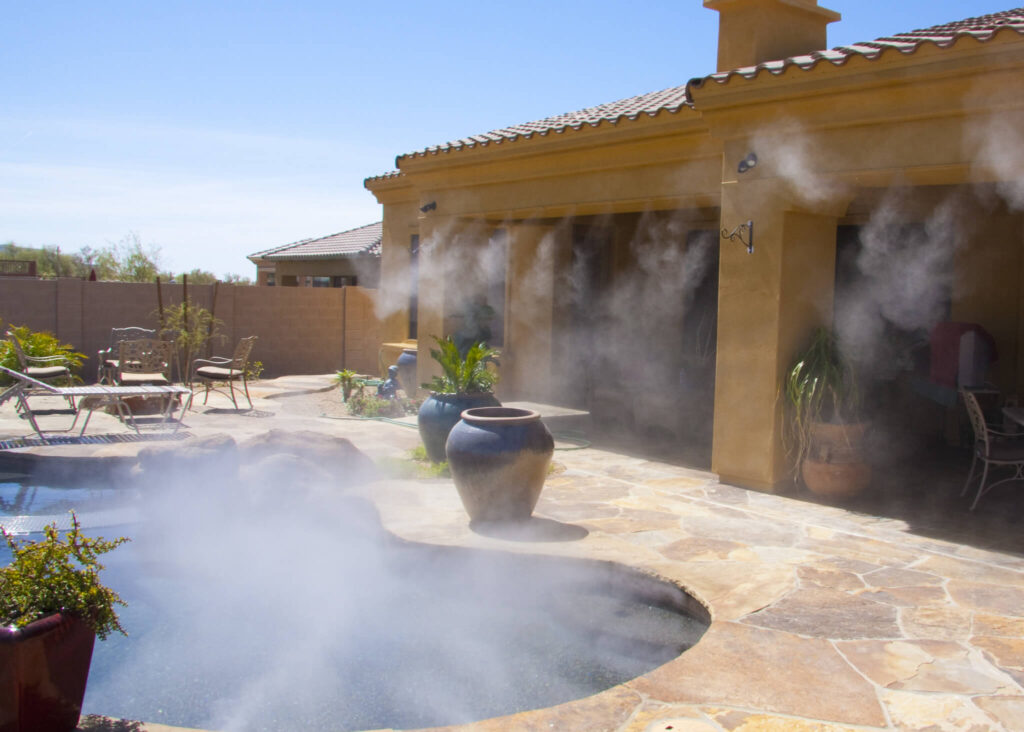
Why does pressure matter so much in California’s climate?
Evaporative cooling only works when the surrounding air has the capacity to absorb more moisture. California’s inland and desert climates give it plenty.
The Coachella Valley typically runs at 10–25% relative humidity on summer afternoons — one of the driest inhabited climates in the country. At that level, fine mist evaporates almost instantaneously, which is why Palm Springs homeowners routinely see 25–30°F temperature drops from a properly installed high-pressure system.
The Inland Empire and High Desert run slightly higher (20–35% RH) but still fall well within the effective range for high-pressure performance. Inland Los Angeles and Orange County work well too, especially in the afternoon hours.
You can see how these systems look installed across different properties in our project portfolio.
Coastal areas require more nuance. Communities like Newport Beach and Long Beach can see summer morning humidity climb to 65–80% when the marine layer is thick. At that level, even fine mist can’t evaporate as efficiently, and temperature drops will be closer to 10–15°F rather than the 25–30°F you’d achieve in the desert.
High-pressure still significantly outperforms low-pressure in coastal conditions — low-pressure systems in humid air don’t evaporate at all; they just wet everything.
For coastal homeowners, the question isn’t whether to install high-pressure; it’s calibrating expectations for morning hours versus the afternoon once the marine layer burns off.
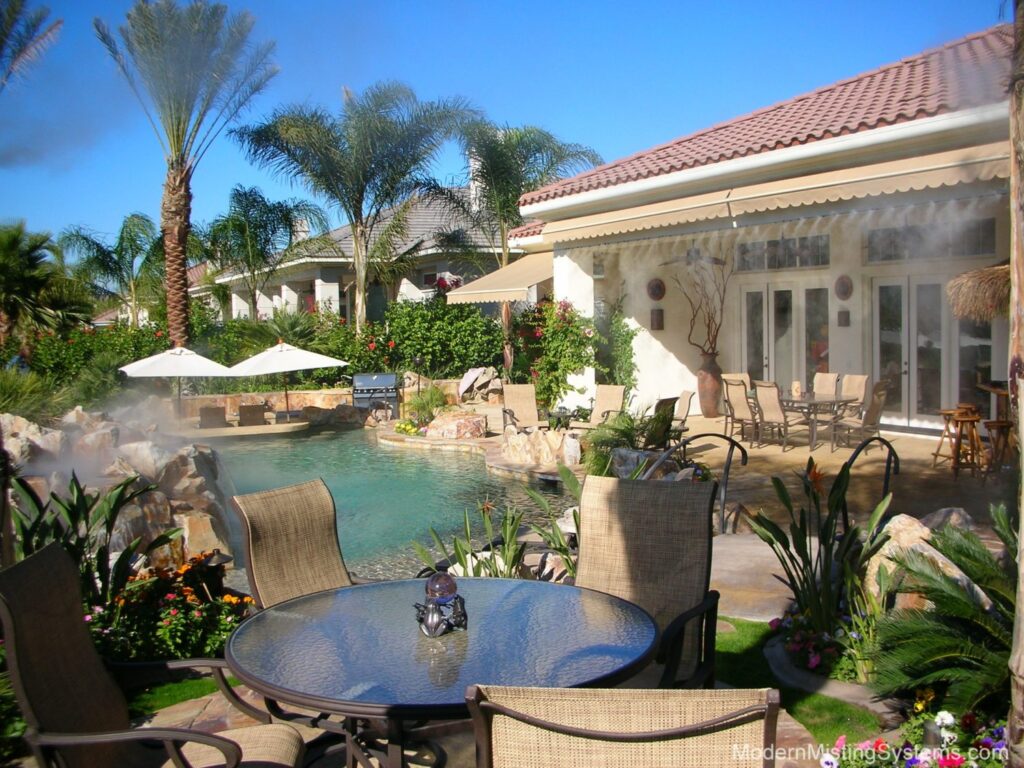
How much water does each misting system use?
This is the question that matters most to California homeowners — and the answer favors high-pressure by a wide margin.
A high-pressure system running at 1,000 PSI uses approximately 1–2 gallons per hour per nozzle. A low-pressure system on tap pressure uses up to 4–5 gallons per hour per nozzle.
For a typical 15-nozzle residential installation running four hours a day, that’s roughly 60–120 gallons at high pressure versus 240–300 gallons at low pressure. Over a 120-day California summer, the water savings are significant — and meaningful on your utility bill.
For context: a high-pressure 15-nozzle system running for four hours uses about as much water as two to four showers. A standard garden hose running at full blast uses more water in two minutes than the same misting system uses in an hour. We go deeper into the gallons-per-hour math in our guide on how much water a misting system uses.
At Coachella Valley water rates, a properly sized high-pressure system costs roughly $40–$80 per season in water — a figure that drops further when you consider that you’re running your air conditioning less because your outdoor space is comfortable.
You can see more in our operating cost breakdown, which shows what a misting system costs in the Coachella Valley.
What does each system cost to buy and install?
Here’s what you might expect when it comes to misting system pricing – from DIY to full professional installation:
- Low-pressure DIY kit (no pump): $20–$300. Attaches to a hose bib; includes tubing, fittings, and plastic or brass nozzles. Works for casual, seasonal use on a small patio.
- Mid-pressure kit with booster pump: $200–$1,500. Better atomization than tap pressure; DIY-installable; limited cooling compared to true high-pressure.
- High-pressure DIY kit with pump: $800–$2,000+. The pump alone from a quality manufacturer runs $700–$1,000. Viable for a handy homeowner on a simple open patio; not recommended for multi-zone systems or patio cover integrations.
- High-pressure professional installation: $2,500–$5,000 for a typical residential setup. This is where you get correct nozzle sizing, proper filtration (essential in the Coachella Valley’s hard water), clean line routing through your patio cover or pergola, and a system warranted to run reliably for 5–10 years depending on equipment grade and maintenance.
- Premium multi-zone installation: $5,000–$15,000+. Custom zoning, smart controls, copper or stainless steel lines, full integration with your outdoor living structure.
Over five to seven seasons, high-pressure saves meaningfully on water, runs cooler, stays drier, and lasts significantly longer.
We analyzed the full cost-benefit case in our post on whether a misting system is worth the investment — for any permanent installation in a California climate, the math favors going high-pressure.
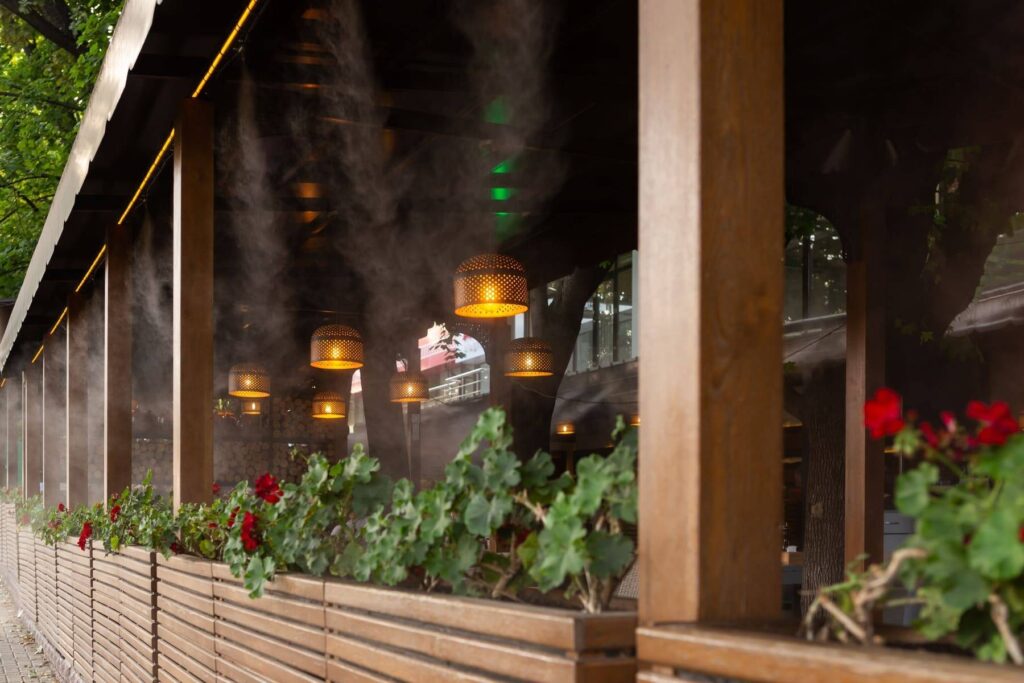
Which system is right for your patio size and situation?
The answer comes down to three factors: your climate zone, how you use the space, and your budget. Use this reference to cut through the decision:
| Your situation | Recommended system |
| Desert / inland valley (Coachella Valley, Inland Empire, High Desert) | High-pressure, professional install |
| Coastal (Newport Beach, Long Beach, coastal LA) | High-pressure; adjust expectations for marine layer mornings |
| Patio under 200 sq ft, seasonal / rental use | Low-pressure DIY kit acceptable |
| Patio 200 sq ft+, permanent installation | High-pressure — ROI favors it within 1–2 seasons |
| Budget under $500, DIY comfortable | Low-pressure or mid-pressure booster kit |
| Budget $1,500+, permanent outdoor living space | High-pressure professional install |
| Outdoor kitchen or electronics nearby | High-pressure only — low-pressure wets surfaces |
| Pergola / patio cover integration | High-pressure; tubing routed through structure |
| Pool deck application | High-pressure; nozzles positioned away from water entry |
| HOA community / luxury patio | High-pressure; clean line routing through cover structure |
On sizing: professional systems are typically designed at one nozzle per two feet of patio perimeter, or one nozzle per six to eight square feet of open area, spaced 24–30 inches apart.
A 400 sq ft patio needs roughly 12–18 nozzles; an 800 sq ft space will need 20–30. Multi-zone setups at that scale require a professional design to ensure consistent pressure across all lines.
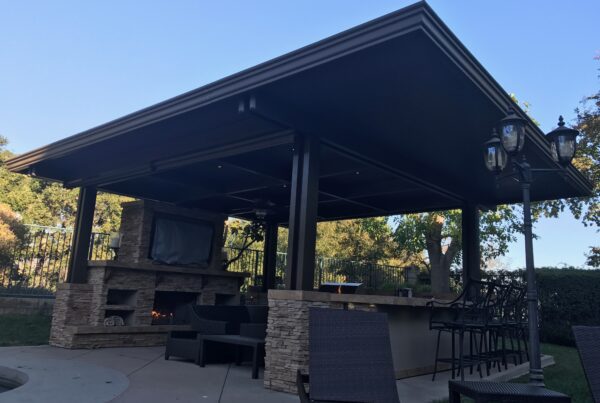
If you want to understand what high-pressure systems look like in different outdoor configurations — pergola-mounted, integrated into a 4K aluminum patio cover, pool deck, or freestanding — our guide to how to cool a patio when it’s 120°F outside walks through the integrated cooling approach in detail.
Ready to stop guessing and start cooling?
If you’re in the Coachella Valley or anywhere in Southern California and ready to move from research to installation, we’d love to talk through what makes sense for your specific patio.
A system that’s correctly designed, properly installed, and sized for your space is one of the best outdoor living investments you can make — and one that pays dividends every time the temperature climbs past 100°F.
Schedule Your Misting System Consultation Today
Frequently Asked Questions
Do high-pressure misting systems work in coastal California?
Yes, but expect different results from the desert. Morning marine layer pushes coastal humidity to 65–80%, which limits temperature drops to 10–15°F instead of the 25–30°F you’d see in Palm Springs. By the afternoon, when the layer burns off, performance improves considerably. Either way, high-pressure still outperforms low-pressure in coastal conditions — low-pressure systems in humid air don’t evaporate; they just wet everything.
How much does it cost to run a misting system per month in California?
For a 15-nozzle high-pressure system running four hours a day, expect $8–$40/month in water and $9–$17/month in electricity — roughly $17–$57/month total. Utility-conscious Coachella Valley homeowners typically land at the low end of that range.
Can I install a high-pressure misting system myself?
Technically, yes — DIY kits run $800–$2,000 and a handy homeowner can install a simple single-level system in 2–4 hours. That said, professional installation matters for nozzle sizing, filtration, and any integration with a patio cover structure. For a permanent luxury installation, it’s worth it.
How many gallons per hour does a patio misting system use?
High-pressure systems use 1–2 gallons per hour per nozzle; low-pressure systems use 4–5. A 15-nozzle high-pressure system running for an hour uses 15–30 gallons total — less than a garden hose burns through in two minutes.
What PSI do I need for a patio misting system?
For true evaporative cooling in California, you need 800–1,200 PSI from a dedicated pump. Tap pressure (40–60 PSI) just sprays you. Mid-pressure boosters reach 150–300 PSI — better, but not the real thing. And don’t be misled by systems marketed as “high pressure” that only hit 160 PSI — that’s a booster, not a high-pressure installation.
How long do residential misting systems last with regular maintenance?
A quality high-pressure system will run 8–10 years on the pump, and stainless steel tubing often carries a lifetime warranty. Nozzles last 5–10+ years with annual cleaning. The weak point is nylon tubing, which UV-degrades in 3–7 years in California sun. Budget $150–$300/year for a professional service visit or plan on 1–2 hours of DIY maintenance each season start.