Key Takeaways
- A patio Cover cost in the Inland Empire is driven more by size, material, and features than by which Inland Empire city you’re in — though permits and site access do move the number.
- 4K aluminum costs more up front than wood and often less over its life, because it doesn’t need sealing, repainting, or early replacement.
- The cheapest quote usually skips something — permits, HOA approval, or structural strength — and that catches up with you later.
- Outdoor living holds its value. The National Association of Realtors reports patios recover a large share of their cost at resale.
- We build across the Inland Empire — Riverside, Rancho Cucamonga, Upland, Redlands, Corona, Chino, San Bernardino — and price a project after we’ve seen the space.
If you’re pricing a patio cover in the Inland Empire, you’ve probably noticed that nobody wants to give you a straight number. We get it, and we’ll do better than that here.
A patio cover isn’t a fixed-price product, so an honest answer starts with what moves the price and what separates a cover worth paying for from one that looks like a deal until it isn’t.
Consider this both a pricing breakdown and a buyer’s guide: what drives the cost, which cover fits your priorities, how to read a quote, and the questions that separate a solid contractor from a cheap one.
We build luxury outdoor living across Southern California, and this is how we walk Inland Empire homeowners through the money.
For the full picture of the system most of this is built around, our complete guide to 4K aluminum patio covers goes deeper into the material itself.
How much does a patio cover cost in the Inland Empire?
The final cost will depend on the size and material, as well as how far you take the design.
For example, a simple shade structure and a fully built, motorized outdoor room are different projects with very different price tags.
What we can tell you is that where you are in the Inland Empire matters far less than what you’re building.
A patio cover in Riverside, Rancho Cucamonga, or Redlands is priced on the same drivers as one in Corona or San Bernardino. Local permit rules and site access can nudge the total, but the design decisions do most of the work.
Rather than quote a number we’d have to walk back the moment we saw your yard, we price a project once we’ve looked at the space. That’s how you avoid the surprise change orders that come with a number pulled out of the air.
If you want a sense of how a premium build gets scoped, our breakdown of luxury patio cover costs lays out the same thinking.
What factors go into the price of a patio cover?
A handful of factors decide most of the cost. Once you know them, the range stops feeling mysterious:
- Size and span. Bigger footprints and longer unsupported spans need more material and more structure. This is usually the single biggest driver.
- Material. Wood, Alumawood, and 4K aluminum sit at different price points and, more importantly, different lifespans. More on that below.
- Attached vs. freestanding. How the cover ties to the house — or stands on its own — changes the engineering and the labor.
- Features. Integrated lighting, fans, or heaters add capability and cost. A motorized louvered roof is the clearest example of a feature that changes the whole project.
- Permits and HOA approval. Most Inland Empire cities require a permit, and many communities add design review. That’s time and paperwork — which we handle.
- Site access. Tight side yards, slopes, or long material carries add labor. An easy backyard is cheaper to build in than a hard-to-reach one.
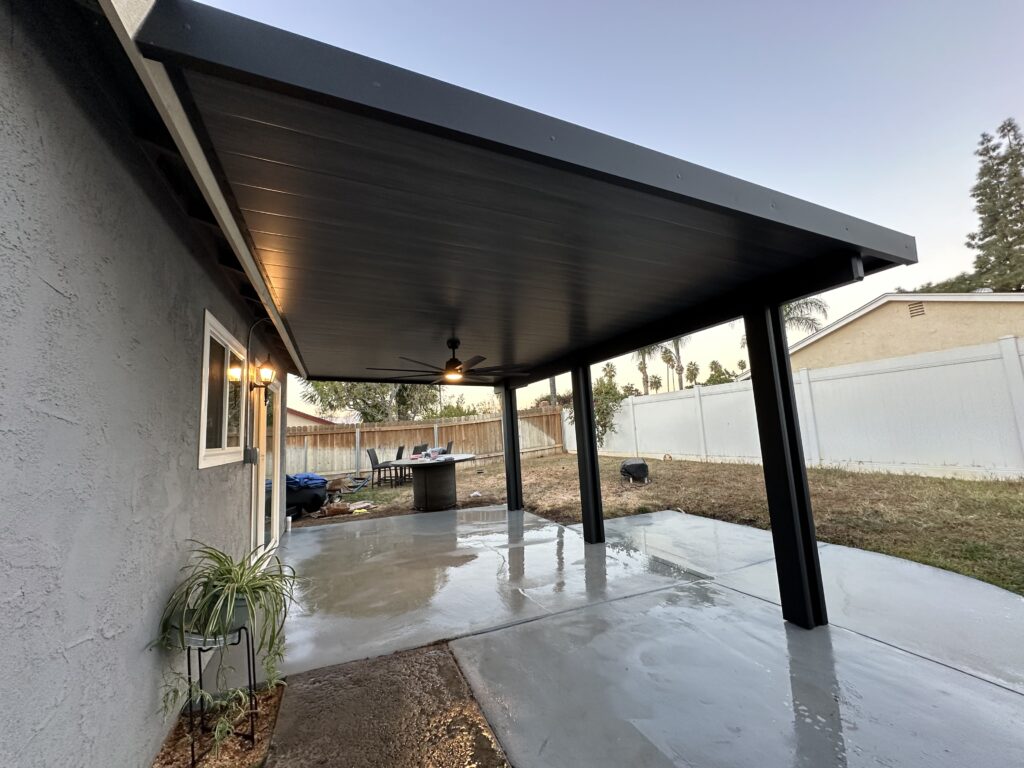
4K aluminum, Alumawood, or wood — which costs less over time?
Up-front price is only half the question. The cover that costs the least to buy often costs the most to keep. Here’s how the three common choices compare on total cost of ownership:
| Cover type | Up-front cost | Lifespan & upkeep | Cost over time |
|---|---|---|---|
| 4K aluminum | Higher | Longest life, minimal upkeep | Often the lowest — no sealing, repainting, or early replacement |
| Alumawood | Mid | Good life, low upkeep | Moderate — solid value with a wood look |
| Real wood | Lower | Shortest life, high upkeep | Can end up highest — sealing, repairs, and eventual replacement |
Aluminum earns that low long-term cost because it protects itself. Exposed to air, it forms a thin, self-renewing oxide layer that resists corrosion, which is why the Aluminum Association points to durability as one of the metal’s defining traits.
Wood, by contrast, wants sealing and resealing and still moves with the seasons. We put the two side by side in our 4K aluminum vs. Alumawood comparison if you want the full breakdown.
Which patio cover is right for you?
There’s no single best cover — there’s the one that fits how you weigh price, longevity, and features. Here’s the short version of how we steer that decision:
| If your priority is… | Best fit | Why |
|---|---|---|
| Lowest price today | Real wood | Cheapest to buy — but budget for sealing, repairs, and eventual replacement. |
| Best long-term value | 4K aluminum | Higher up front, usually the lowest cost over its life. Minimal upkeep. |
| Wood look, low upkeep | Alumawood | The warmth of wood without the sealing and repainting, at a mid budget. |
| Motorized roof, lighting, fans | 4K aluminum | The strongest frame for integrated systems and long unsupported spans. |
Most Inland Empire homeowners who plan to stay in the house land on 4K aluminum, because the daily heat means the cover earns its keep and the low upkeep pays off over the years you own it.
Is a patio cover worth it in the Inland Empire?
For most homeowners here, yes — and the reason is that you’ll use it.
Inland Empire summers are long and hot, so a shaded, comfortable outdoor room isn’t a once-a-year showpiece. It’s usable living space for a good chunk of the year.
The money tends to hold, too. The National Association of Realtors reports that outdoor living ranks among the features buyers most want, that many will pay a premium for it, and that patios recover a large share of their cost at resale.
We break down the resale side further in our look at the ways a patio cover adds home value. A well-built cover reads as part of the house, not an add-on bolted to the back of it.
Do you need a permit, and what does it add?
Usually yes. Most Inland Empire cities and both Riverside and San Bernardino counties require a building permit for a patio cover, and many neighborhoods layer HOA or architectural review on top.
Skipping it is how projects get red-tagged and how covers become a problem at resale.
What it adds is mostly time, not a mystery fee — the permit itself is modest, but the review can stretch the timeline if the submittal isn’t right. We prepare and pull the permits and handle any HOA package, so approvals stay our job instead of your headache.
Our guide to HOA approvals walks through how that process tends to go, and our guide to planning an outdoor living project covers where permitting fits in the overall timeline.
How to buy a patio cover in the Inland Empire, step by step
If you want a simple path from “I think I want a cover” to “it’s built,” this is the order that keeps you out of trouble:
- Get clear on how you’ll use it. Shade for the dogs and a coffee spot is a different build than an outdoor kitchen and TV room. Decide the job before you price it.
- Set your priorities. Rank lowest price, longest life, and most features. That ranking picks your material more than anything else — see the table above.
- Lock size and must-have features. Rough footprint, attached or freestanding, and any motorized roof, lighting, or fans. These are your biggest cost levers.
- Get itemized quotes, not ballparks. Ask for line items — material, engineering, permit, HOA, labor. A number scribbled on a card is not a quote.
- Check permits and HOA early. Confirm what your city and community require before you fall in love with a design that won’t get approved.
- Compare on value, then decide. Put the bids side by side on the same line items — not just the bottom number — and pick the one built to last.
What questions should I ask a patio cover contractor before investing?
Bring these to every estimate. The answers tell you as much as the price does — and a good builder will welcome all of them:
- Are the permit and engineering included in this price, or extra?
- What material and gauge are you using, and why that spec?
- Do you prepare and submit the HOA package, or is that on me?
- What’s the warranty on materials and on your workmanship — and is it in writing?
- Can I see local projects like mine? Can I talk to those homeowners?
- What could change this price after we start?
- Who’s my point of contact during the build?
Why are some patio cover quotes so much cheaper?
Likely because something got left out. When one quote comes in well under the others, it’s worth asking what’s missing before you sign it.
The usual cuts are the ones you can’t see on paper: no permit or HOA handling, thinner-gauge materials that flex and fade, undersized framing that struggles in wind, or a crew that disappears when there’s a warranty question.
The number looks better today and costs more over the life of the cover.
Paying a fair price for a cover that’s engineered, permitted, and built to last is the smart-investment version of this decision.
You can see the standard we hold on our work, and the kind of company we’ve become for people who want it done once and done right.
How to compare patio cover quotes
The bottom-line number is the last thing to look at, not the first. Line the bids up on what’s included, and the “cheap” one usually stops looking cheap:
| Line item | Why it matters | What a real quote shows |
|---|---|---|
| Material & gauge | Thin-gauge covers flex, fade, and dent. | Named material and thickness, not just “aluminum.” |
| Permit & engineering | Unpermitted work gets red-tagged and hurts resale. | Permit and engineering included and priced. |
| HOA handling | A rejected design stalls the whole project. | They prepare and submit the HOA package. |
| Warranty | Verbal warranties vanish when you need them. | Materials and workmanship, in writing, with terms. |
| Change orders | Lowball bids get “corrected” mid-build. | What is fixed, and what could move the price. |
| Cleanup & site | Hidden costs show up at the end. | Haul-off and site restoration spelled out. |
A faster gut check: scan each quote for these signals before you weigh the price.
| Green flags? Good sign – An itemized, written quote – Permit and engineering included – Handles the HOA submittal for you – A named, written warranty – Local references and a real project portfolio | Red flags? Slow down – A one-line price or a verbal number – “The permit’s on you” – Vague material specs (“premium aluminum” – No warranty in writing – Pressure to sign today for a “today only” price |
Ready to get a real number for your yard?
Tell us about your space and what you want the backyard to become, and we’ll price it honestly after we’ve seen it — no guesswork, no surprise change orders.
Start your project with Horizon Patios, or look through our patio cover options and wider outdoor living solutions first. We build across the Inland Empire and all of Southern California, and we’d rather earn the job than win it on the lowest bid.
Frequently Asked Questions
How much does a patio cover cost in the Inland Empire?
It depends on size, material, and features more than on your city. A simple shade cover and a large, motorized outdoor room are very different projects, so we price a build after seeing the space rather than quoting a number we’d have to revise. Our luxury patio cover cost breakdown shows how the scope comes together.
Is 4K aluminum more expensive than Alumawood?
Up front, usually a bit — but over the life of the cover it often costs less, because it doesn’t need sealing, repainting, or early replacement. The 4K vs. Alumawood comparison breaks down where each one makes sense.
Does a patio cover add value to my home?
It can. Outdoor living is one of the features buyers most want, and patios recover a large share of their cost at resale, according to the National Association of Realtors. In the Inland Empire’s climate, a shaded outdoor room also adds real, usable living space.
Do I need a permit for a patio cover in Riverside or San Bernardino County?
In most cases, yes, and many communities also require HOA or design review. We prepare and pull the permits and handle the HOA package, so approvals stay our responsibility. Our HOA approvals guide explains the process.
Why are some patio cover quotes so much cheaper?
Usually because something’s left out — permits, thicker materials, proper framing, or warranty support. The low number today often costs more over the life of the cover. It’s worth asking any low bid exactly what’s included.
Does Horizon Patios build in the Inland Empire?
Yes. We build luxury patio covers and outdoor living spaces across Riverside, Rancho Cucamonga, Upland, Redlands, Corona, Chino, San Bernardino, and the wider Inland Empire, along with the rest of Southern California. See areas we serve for the full list, or explore neighboring builds in Long Beach and Newport Beach.