Key Takeaways
- Realtors and appraisers publish very different numbers for patio cover worth when it comes to selling. The gap comes from what each one measures, not who’s right.
- A patio cover never counts toward your home’s appraised square footage, no matter its size or quality. Appraisers score it as a feature, the same category as landscaping or a pool.
- In gated golf and country-club communities, the backyard is often the reason a buyer books a showing in the first place, not a bonus once they’re through the front door.
- An unapproved patio cover or backyard addition can slow down a closing in an HOA or architectural-review community, separate from any question of value.
- Most real estate agents don’t recommend building a new patio cover purely to sell. A well-kept space you already have does more for a showing than a rushed addition.
Your agent walks the backyard before the first showing and says it needs work before the house goes on the market. You built this patio cover for your family, on your own schedule, with your own taste.
Now you’re being asked what a stranger will pay for it.
There’s a gap there. The right answer (and, as you can imagine, there may be multiple “right answers”) comes from two professions that measure different things. There’s also a pattern specific to golf and country-club communities that neither usually accounts for.
We build and maintain patio covers across La Quinta, PGA West, Indian Wells, and Rancho Mirage, communities where a backyard gets measured against a country-club standard whether the seller planned for that or not, whether you live there full time or you’re selling one of several homes.
Here’s what we’ve found – and what may help you make the right decisions for your property.
Two Numbers to Answer One Question
Knowing how much your patio cover will be worth depends on which measure you’re asking about.
Ask a realtor, and you’ll likely hear that a new patio recovers close to all of its initial cost. Look at the report built from appraiser data instead, and the number drops by roughly half.
The Realtor Estimate: 95%
The National Association of Realtors and the National Association of Landscape Professionals publish a joint report on outdoor remodeling, built from what surveyed real estate agents estimate a seller could recoup. Their most recent edition puts a new patio at 95% cost recovered.
The Appraiser Estimate: 47%
Zonda’s Cost vs. Value report uses a different method: real contractor costs, checked against resale estimates from licensed appraisers in each market.
For a backyard patio, that number comes in at 46% nationally, and 47.2% in the Los Angeles/Pacific region, the closest regional data available to the Coachella Valley.
Which Number Should You Plan Around?
The same feature, in the same country, comes out roughly 48 points apart, because the two reports aren’t measuring the same thing.
A wood deck tells a similar story in the opposite direction: it recovers 89 percent nationally per the realtor-estimate report, and 99.6 percent in the same Los Angeles/Pacific appraiser data.
Which number applies to your project depends on which question you’re asking: how a buyer feels about the space, or what an appraiser will put in writing.
| Outdoor Project | Realtor-Estimated Recovery (NAR/NALP) | Appraiser-Based Recovery (Cost vs. Value, LA/Pacific) |
|---|---|---|
| Backyard patio | 95% | 47.2% |
| Wood deck addition | 89% | 99.6% |
| Composite deck addition | Not tracked separately | 73.9% |
| Outdoor kitchen | 100% | Not tracked in the report |
| Overall landscape upgrade | 100% | Not tracked in the report |
Square Footage and the Appraisal Rulebook
A patio cover doesn’t count toward appraised square footage, regardless of size, materials, or quality.
Appraisers calculate Gross Living Area using the ANSI Z765-2021 standard, and it draws a hard line: patios, decks, porches, and balconies are excluded from GLA outright.
The only way outdoor space counts as living area is if it’s fully enclosed, heated or cooled, and permitted as conditioned space. A standard patio cover, however well built, doesn’t qualify.
How Does a Patio Cover Get Priced?
Instead, a patio cover is priced in the sales-comparison grid as a feature or amenity adjustment, the same bucket as landscaping or a pool. Design, durability, and how well the space reads at a showing carry more weight in that adjustment than raw dimensions do.
If you’re weighing the investment itself before you build rather than before you sell, our planning guide for a luxury outdoor living project and our broader look at how a luxury patio cover affects home value in Palm Desert both cover that ground in more depth than we will here.
What Draws a Buyer Through the Gate?
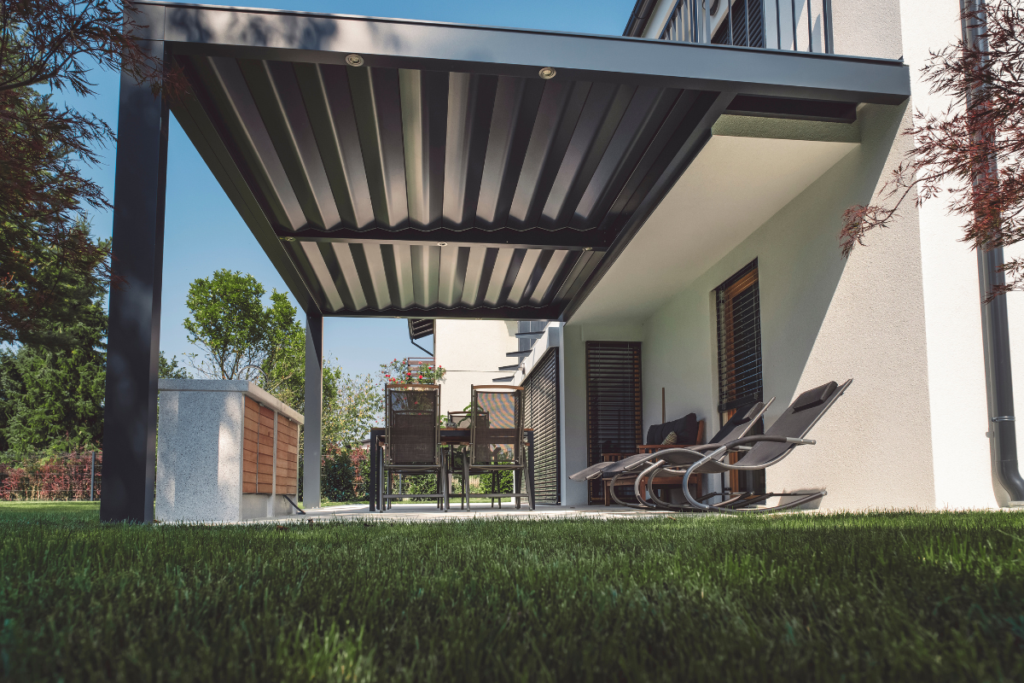
In country club communities, it’s often the backyard – and it’s often before the buyer ever steps inside the home.
Real estate agents who work gated golf communities often report that the outdoor space is frequently why the showing got booked at all.
Outdoor living, alongside pools and screened porches, is what helps a home stand out in a golf-oriented, amenity-rich market.
The pattern is consistent enough across comparable gated golf communities that it’s worth planning around.
HOA Paperwork and Your Closing Timeline
It can slow things down, mostly as a timeline risk, not a value risk.
The Approval Risk
Many gated golf and country-club communities, La Quinta’s PGA West among them, require architectural review committee approval for additions like patio covers, fire features, outdoor kitchen builds, and more.
If a past addition never went through that process, it can surface during a sale. A buyer’s agent, a title search, or the HOA itself may ask for documentation that doesn’t exist.
That’s a delay a seller doesn’t want discovered two weeks before closing.
Get Ahead of It Before You List
Requirements and review timelines vary by association. Every community sets its own process and its own pace, and some move faster than others.
Rather than re-walk that ground here, our guide to HOA approvals for luxury outdoor upgrades details the process.
If you’re planning to sell within the next few years, confirming your paperwork now is easier than reconstructing it under a closing deadline, especially if you’re coordinating the sale from out of state or through a property manager rather than in person.
Upgrade Before You List, or Let It Ride?
Usually, leave it, unless what’s there is working against you rather than for you.
What the Recommendation Data Shows
Go back to the same NAR/NALP survey, and the recommendation data tells some interesting data that backs up much of what we’ve been writing about.
| Improvement | Share of Realtors Who Recommend It Before Listing |
|---|---|
| Routine landscape maintenance | 74% |
| Standard lawn care service | 53% |
| Tree care | 44% |
| Overall landscape upgrade | 23% |
| Landscape lighting | 11% |
| New patio | 3% |
| Outdoor kitchen | 1% |
| In-ground pool | 1% |
As you can imagine, building a new patio cover purely to sell is a weak bet based on that data, and the appraiser-based recovery number backs it up. But having one doesn’t hurt you!
A well-kept, cohesive space you already have will generally do more for a showing than a rushed addition timed to a listing date.

When Condition Works Against You
Sometimes, the condition of your outdoor space can work against you.
A patio cover that’s visibly deteriorating or built without the finish quality the rest of the property suggests can work against a listing the same way a dated kitchen would.
That’s particularly true in a community where buyers are comparing the whole property to a country-club standard.
If that’s closer to your situation, our pieces on 4K aluminum vs. Alumawood and whether a motorized louvered roof is worth the investment are good places to gauge whether your structure still reads as an asset or has quietly become a liability.
And if the issue is closer to upkeep than design, what a Coachella Valley summer does to a patio cover is worth a look before your next showing season, along with a quick check of your misting system and hardscape if either is part of the space a buyer will see.
Talk to Us About What Your Outdoor Space Is Worth
Whether you’re building for your own family or thinking a few years ahead to a sale, the same design decisions carry both purposes at once.
Tell us how you use the space now, and we’ll build it to hold up under both questions. Start your project today, or read more about our patio covers and the rest of what we build.
Frequently Asked Questions
Does a patio cover increase your home’s resale value?
It depends which report you’re reading. Realtor-estimate data puts recovery near 95 percent; appraiser-based data puts it closer to 47 percent in Southern California. Plan around the more conservative, appraiser-based figure if resale value is the reason you’re building.
Why do different sources give different numbers for outdoor project ROI?
Realtor-estimate reports measure buyer appeal and agent sentiment. Appraiser-based reports measure what a licensed appraiser will put on a comparable-sales grid. They’re answering different questions, not disagreeing about the same one.
Does a patio cover count toward a home’s appraised square footage?
No. The ANSI Z765-2021 standard excludes patios, decks, porches, and balconies from Gross Living Area regardless of size. A patio cover is priced instead as a feature adjustment, the same category as landscaping.
Do buyers in golf and country-club communities expect a finished outdoor living space?
Real estate agents in comparable gated golf communities report that the backyard is often the reason a buyer books a showing at all. National buyer research shows patios rated essential or desirable by the large majority of buyers, and that desire for outdoor features rises with home price.
Can an unapproved patio cover delay a home sale in an HOA community?
It can. Many gated golf communities require architectural review sign-off for patio covers and similar additions. Missing paperwork can surface during a sale and needs to be resolved before closing, separate from any question of the addition’s value.
Should you upgrade your patio cover before listing your home, or leave it for the buyer?
Usually leave it. Only 3 percent of surveyed real estate agents recommend building a new patio specifically before a sale. A well-maintained existing space helps more than a rushed addition, unless the current structure is visibly dated or deteriorating, in which case it can work against the listing.