Key Takeaways
- Shade solves radiant heat, not air temperature. A covered patio in Palm Springs is still sitting in 109°F air.
- The Coachella Valley is close to ideal for evaporative cooling — July averages 109°F at 27% relative humidity, and the drier the air, the more cooling you get.
- The U.S. Department of Energy puts direct evaporative cooling at 15°F to 40°F of temperature reduction in dry climates.
- High-pressure systems produce droplets small enough to evaporate before they land, which is why a properly specified system cools without wetting furniture.
- Cooling designed into the patio cover disappears into the structure. Cooling added afterward is always visible.
Why does my covered patio still feel so hot in the Coachella Valley?
We get this question a lot. And it’s not because of some issue with the patio cover. It’s typically because shade and cool air are two different problems. A patio cover only solves one of them.
Let’s get a bit scientific. Heat reaches you outdoors two ways:
- Radiant heat is the sun striking your skin, your furniture, and the concrete underfoot.
- Convective heat is the temperature of the air itself
A 4K aluminum patio cover eliminates the first almost entirely — surfaces in the shade run dramatically cooler than the same surfaces in full sun.
It does nothing to the second. At two in the afternoon in July, 109°F in the shade is still 109°F.
This is the part that frustrates homeowners who did everything right. You invested in a beautiful structure, the space looks exactly the way you pictured it, and you still cannot use it for four months of the year.
The cover is not the failure. It is half of a system, and nobody told you about the other half.
How much can misting cool a covered patio?
In typical Coachella Valley conditions, a properly specified system can drop the air under your cover by 20 to 30 degrees.
The Department of Energy puts direct evaporative cooling at a 15°F to 40°F reduction in appropriate climates.
The reason the range is that wide is – as you might have guessed – humidity.
Evaporative cooling turns liquid water into vapor, and that phase change pulls heat out of the surrounding air. Dry air absorbs vapor readily. Humid air is already close to saturated, so there is nowhere for the water to go.
The Department of Energy’s rule of thumb is that anywhere with a summer wet-bulb temperature of 70°F or lower is suitable. The Coachella Valley clears that comfortably. Palm Springs averages a July high near 109°F at about 27% relative humidity.
That combination — punishing heat and very little moisture in the air — is close to the ideal case.
A 2024 review in Buildings found direct evaporative systems reach 60% to 90% effectiveness in hot, dry conditions while delivering less than 5°C of cooling in humid environments.
Put plainly: the same system that barely works in Houston is close to its best-case scenario in Palm Desert.
Wondering what all that evaporating water costs you? You can find out more in our guide to misting system water use.
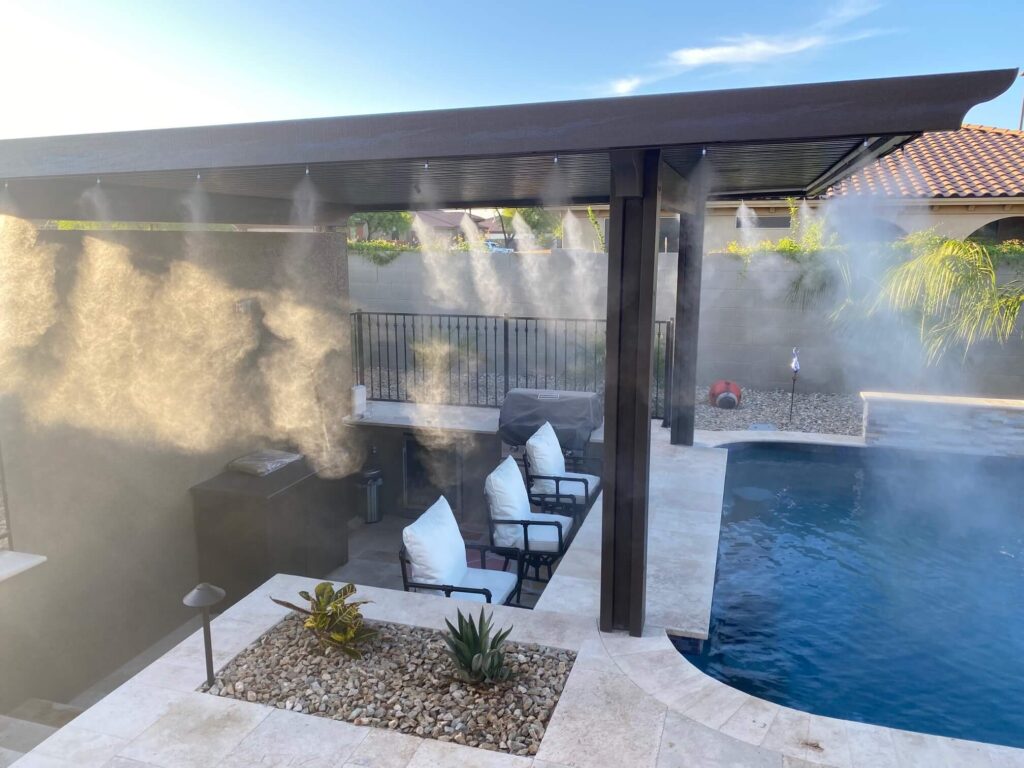
What is dry mist, and why doesn’t it get you wet?
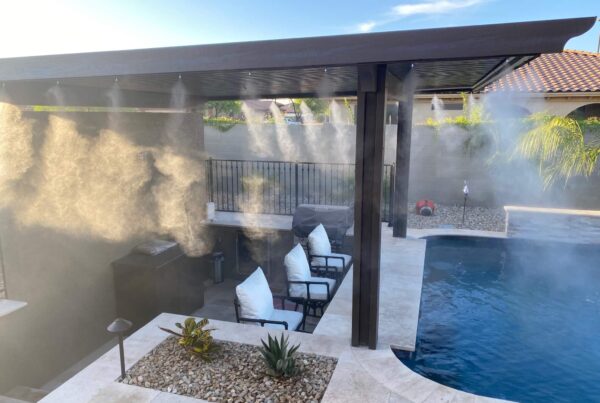
Dry mist is water broken into droplets so small they evaporate completely in mid-air, before they ever reach a person or a surface. The effect is a drop in air temperature with no dampness at all.
It’s all about pressure. Forcing water through a very small hole at high pressure atomizes it into a fog measured in microns. Those droplets have enormous surface area relative to their volume, so they flash to vapor almost instantly.
Low-pressure systems — the kind that run off a garden hose bib — can’t atomize water that finely. They produce visible droplets that behave like light rain. That means they land on your table and your cushions before evaporation gets a chance.
So when someone tells you “misting systems soak everything”, they are describing a pressure class, not the technology. It is the single most common reason a homeowner writes off misting after a bad experience with a hardware-store kit.
What size system does your patio need?
Sizing comes down to four things:
- The length of the run
- The height of the cover
- How open the space is to prevailing wind
- How you use it.
Here is roughly how it breaks down:
- Small covered seating area (under 200 sq ft). A single perimeter run along the outer beam is usually enough. This is the most common Coachella Valley retrofit and the least complicated.
- Full outdoor room (200–500 sq ft). Two runs, typically perimeter plus a center line, so the cooled air reaches the middle of the space rather than hugging the edges.
- Outdoor kitchen and dining. Zoning matters more than raw coverage. You want the dining area cooled and the cooking area left alone — nobody wants mist drifting across a hot grill or a prep surface.
- Pool-adjacent patios. Wind exposure is the deciding factor. Open pool decks lose cooled air quickly, so nozzle placement follows the prevailing breeze rather than the structure.
Higher covers need more volume, because you are cooling more air before it reaches seated height. And a cover open on all four sides behaves very differently from one with a wall or a screen on the windward side.
This is why we will not quote a system off a photo. We look at the orientation, the ceiling height, and where you site – everything matters when you’re looking at a long-term solution.
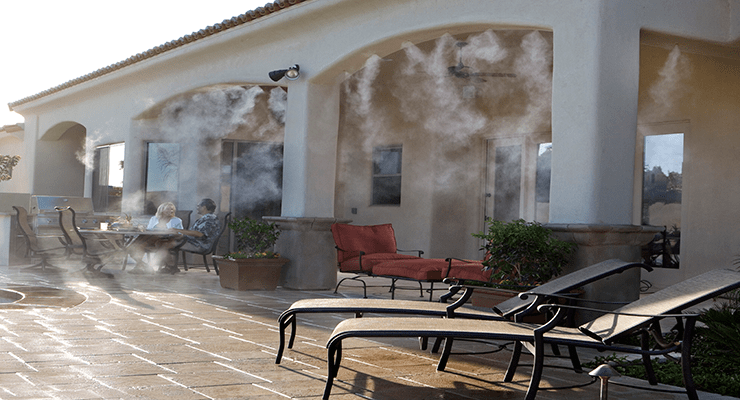
How does cooling get built into a 4K aluminum patio cover?
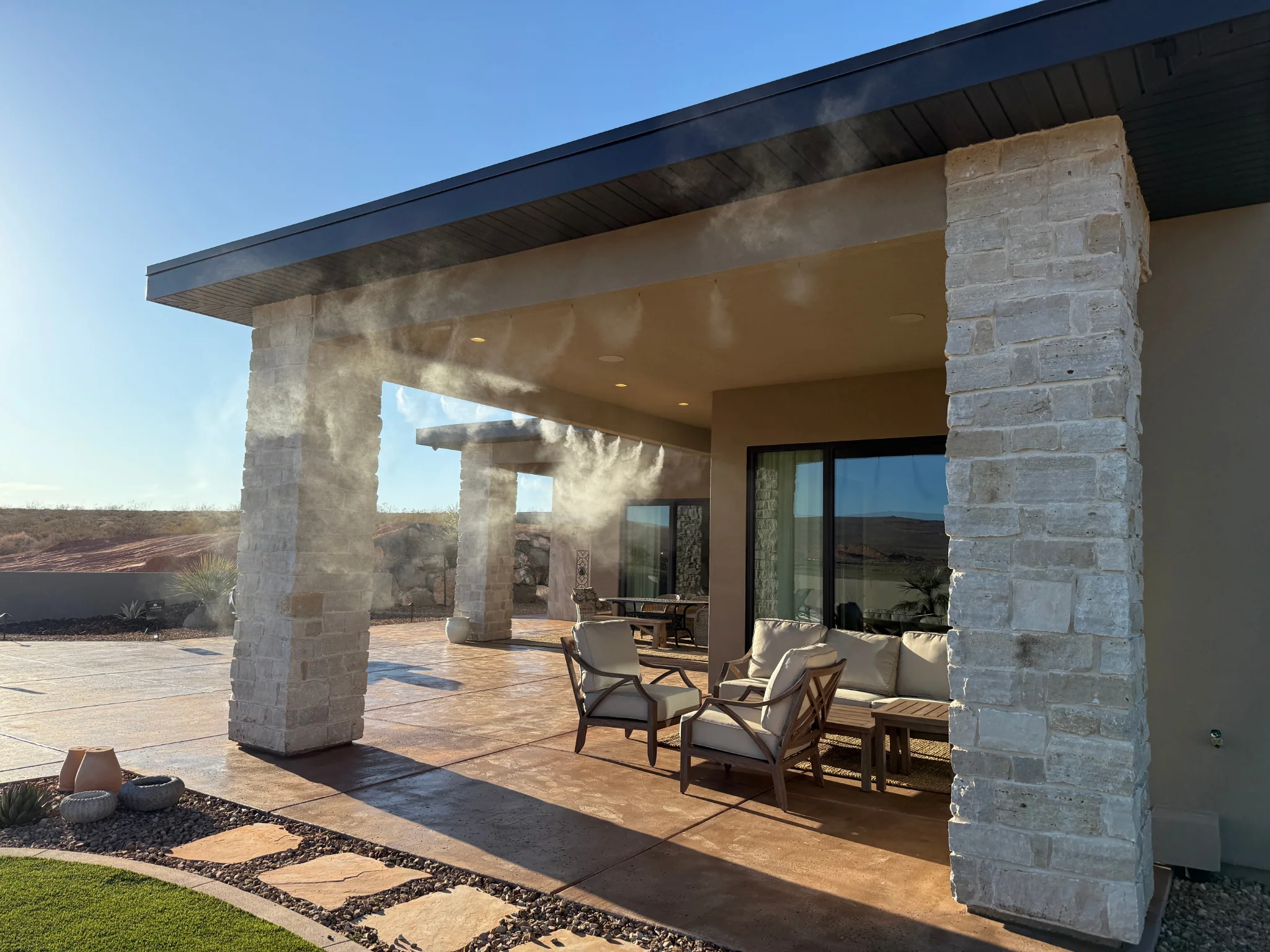
When cooling is designed in from the start, the lines run inside the structure and the nozzles sit flush with the beam. You see the cover. You do not see the system.
That is only possible because of how 4K aluminum patio covers are built.
The extruded sections are hollow and sealed, which gives us a concealed chase to route tubing through. Nozzle positions get set at the design stage and spaced to the beam layout, so the finished ceiling reads as a clean architectural line.
A retrofit cannot do that. Tubing gets surface-mounted along the underside of an existing structure, secured with clips, and it is visible from every seat in the space. It works, and we install plenty of them — but it always looks like something that was added later, because it was.
This is the case for deciding on cooling while the patio cover is still on the drawing board rather than a year after it goes up. The same is true of our misting and cooling systems generally — they are a design decision before they are a purchase.
Material matters here too!
You are running water through a structure in a climate with hard water and intense UV. Aluminum’s natural corrosion resistance is a large part of why we build in it.
If you are weighing materials, we compared the two most common options here.
Do you need fans too, or does misting handle it?
In the Coachella Valley, mist plus modest air movement beats either one on its own. The reason is straightforward: evaporation needs somewhere for the vapor to go.
Under a solid cover on a still afternoon, the air directly around the nozzles becomes locally saturated. Cooling slows down not because the system is undersized but because the humid air is not moving away. Gentle circulation clears it and keeps the process running.
Fans alone have the opposite problem. Moving 109°F air across your skin does very little once ambient temperature climbs past body temperature — you feel wind, not relief.
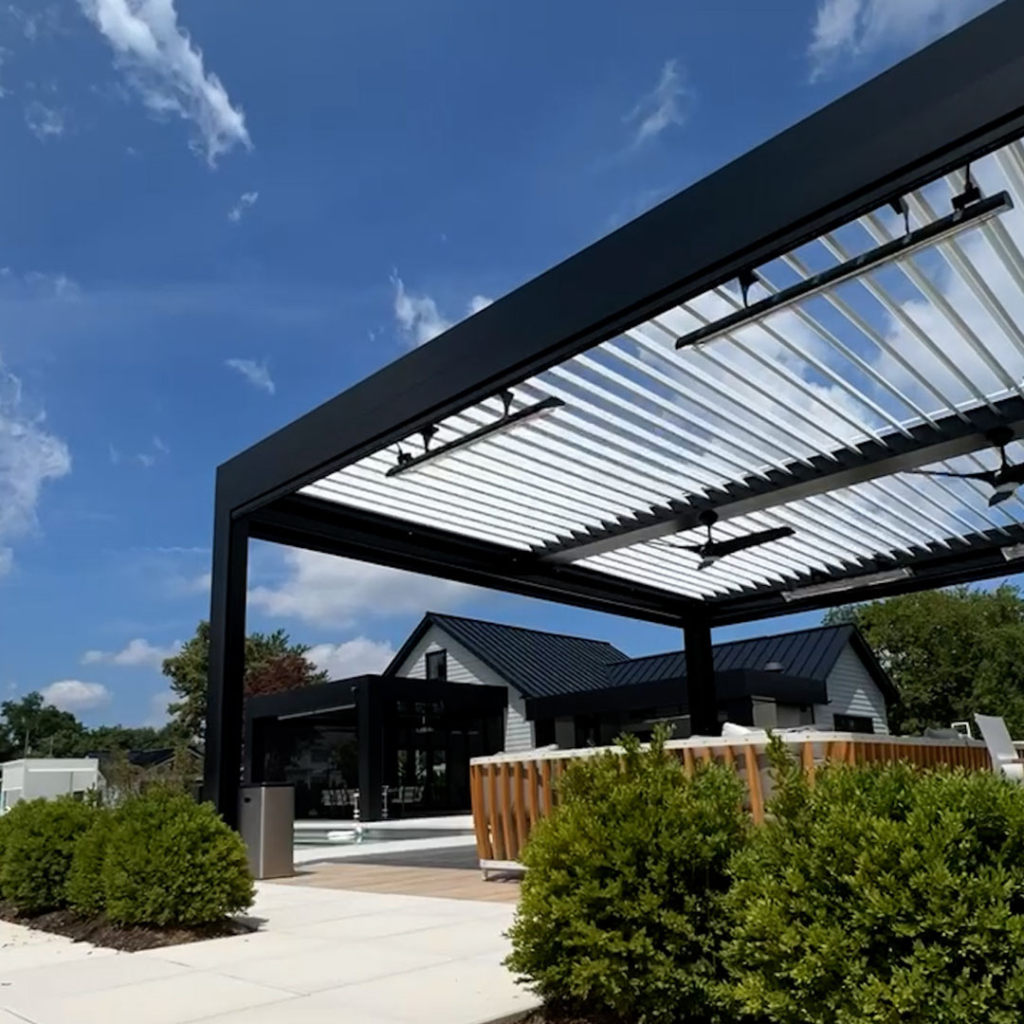
A motorized louvered roof gives you a third lever, letting you open the ceiling on a mild evening and close it against the afternoon sun. Between shade, evaporative cooling, and airflow, most Coachella Valley patios can be made comfortable through the worst of the summer.
You can see how these pieces come together across our completed projects, and how cooling fits alongside the rest of what we build in outdoor living solutions.
Ready to use your patio in July? Let’s look at the space.
Sizing genuinely depends on your patio — its orientation, its height, and how you live in it. We serve Palm Springs, Palm Desert, Rancho Mirage and the wider Coachella Valley.
Start your project today – we’ll walk the space with you before anyone talks about equipment, so you know exactly what to expect and what to consider well before a contractor shows up.
Frequently Asked Questions
What is the best misting system for a patio in the desert?
For Coachella Valley conditions, a high-pressure system integrated into the patio cover. High pressure produces droplets fine enough to evaporate before landing, and integration keeps the lines concealed. The right size depends on your run length, cover height, and wind exposure.
How much cooler does a misting system make a covered patio?
The Department of Energy puts direct evaporative cooling at 15°F to 40°F of reduction in suitable climates. In Coachella Valley summer conditions — roughly 109°F at 27% humidity — a well-specified system under a cover typically delivers toward the upper half of that range.
What is dry mist technology?
Dry mist is water atomized into droplets small enough to evaporate completely in the air, cooling it without leaving moisture on people or surfaces. It requires high operating pressure. Low-pressure systems cannot produce droplets fine enough, which is why they feel damp.
Will a misting system get my furniture wet?
Not if it is specified correctly. Wetness is a symptom of droplets that are too large to evaporate before they land, which comes down to pressure and nozzle selection. A properly designed high-pressure system leaves cushions, tables, and glassware dry.
How much does a patio cooling system cost?
Cost is driven by the length of the run, the number of nozzles, the pump class, whether lines are concealed inside the structure or surface-mounted, and whether the system is built in during construction or retrofitted afterward. Integrated systems cost more up front and less over their life, because nothing is exposed to UV or accidental damage.
Can cooling be added to an existing patio cover, or does it need to be built in?
It can absolutely be added, and we retrofit existing covers regularly. The difference is appearance rather than performance — retrofitted lines are surface-mounted and visible, while integrated lines run inside the structure. If a new cover is already in your plans, building the cooling in at the same time costs less and looks considerably better.